Showing posts with label 'Paul Nash in Pictures: Landscape and Dream'. Show all posts

Wednesday, 20 March 2013

Three Dates for April


By a strange quirk of planning I'm doing talks on three consecutive Thursdays next month, each one rather different from the rest.

I'm delighted to be speaking at Bankside Gallery in London on April 11, at the invitation of the Royal Watercolour Society, on the subject of Eric Ravilious: Travelling Artist. This is the theme of the fourth book in the Ravilious in Pictures series (which was supposed to be a trilogy) and it's great fun to talk about. Rav was a talented letter writer with a wonderful sense of humour, so there's plenty of opportunity to go behind the scenes of his pictures and find out what he was up to, and with whom.

This talk has SOLD OUT, so apologies if you've missed out this time.


All change the following week, when (on April 18) I'm travelling to Chichester to give a talk on Paul Nash at the Pallant House Gallery. I'm excited about this one too, partly because Pallant is such a fabulous institutions and partly because my lecture coincides with an exhibition of Paul Nash prints, photographs, collage and books from a collection that once belonged to his great patron and friend Clare Neilson. It sounds as though there's some fabulous stuff in the collection, which was donated by Clare's godson Jeremy Greenwood and Alan Swerdlow, through the Art Fund, and I'm looking forward to seeing it.

My talk will be based on 'Paul Nash in Pictures: Landscape and Dream', but will focus particularly on Nash's long friendship with Clare Neilson.


It's back to Ravilious, then, for the final leg, and for me an opportunity to talk about my new book, 'Ravilious: Submarine', at the National Maritime Museum in Greenwich (free, but you need to book). I wanted to do this partly because NMM staff were so helpful when we were putting the book together, plus I used to live in Greenwich and walk past the Museum every day, so there's a bit of nostalgia involved! I'll be talking about both the making of the Submarine Series and about life aboard a Royal Navy submarine during World War II, so it should be fun.


Saturday, 3 December 2011

Eric Ravilious & Paul Nash in Bristol

Eric Ravilious, Bristol Quay, 1938
Bristol has been a popular destination for the wandering artist since at least the 18th century, when the Avon Gorge began attracting painters who were looking for something Sublime (cliffs, ruins, etc), but didn't want to go dragging all over Wales looking for it. Since then the port city and its scenic surroundings have proved a fertile hunting ground for generations of artists, and today Bristol must boast one of the highest per capita population of creative types in the country.

JMW Turner, The Avon Gorge & Bristol Hotwell, 1792 (Bristol Museums & Art Gallery)
This was brought home forcibly to me when I went to the launch of Francis Greenacre's lovely book 'From Bristol to the Sea' (Redcliffe) - it must be more than five years ago now - at the Merchant's Hall in Clifton. The great and the good of the city were out in force, I remember, and quite rightly, as the book is a gem - a nicely-produced, readable survey that includes some lively watercolours by a 16 year old JMW Turner; he spent a family holiday perched on the cliffs with his sketchbook, pursuing his vision with typical dedication.


Francis Danby, St Vincents Rocks & The Avon Gorge, 1815 (private collection)

Bristol at the time was becoming something of a fashionable watering hole, on account of the allegedly health-giving waters of the Hotwells, so there was a market for scenes of the city and environs. John Sell Cotman painted an unusual, atmospheric watercolour of St Mary Redcliffe Church, while Thomas Girtin, Francis Danby and Samuel Jackson were among the many popular painters who worked here.

John Sell Cotman, St Mary Redcliffe, Bristol; Dawn, etching after 1802 w/c
Later in the 19th century the attention of artists turned from scenic views to shipping and industry. With its unique layout, the port of Bristol - the City Docks, rather than the port at Avonmouth - offered unusual perspectives that combined features of city life (church spires, shops, crowds) with ships and the activity surrounding them. This remained an attraction for artists into the 20th century. Edward Wadsworth was sent to Bristol during World War One to supervise the painting of ships with dazzle camouflage, and he then recommended the place to a younger artist friend, John Nash.

Nash visited in the 1920s and then returned in November 1938, bringing with him Eric Ravilious. Nash had been trying to get Rav to Bristol for a while, but what really persuaded his friend was the prospect of the paddlesteamers laid up in their winter berths. These lovely old boats, run by P&A Campbell around the Bristol Channel during the summer months, were exactly the kind of subject Ravilious enjoyed, and the pair spent days and, more often, nights sketching them. The resulting pictures give a fascinating insight into the way each artist worked, and I also like to imagine them sitting side by side on the docks with their easels, each intent on his version, perhaps pausing to share a nip of something against the cold.

John Nash, Britannia, 1938 (pic borrowed from Dru Marland)
There was a certain rivalry between the Nash brothers which may partly explain, I think, Paul's comparative lack of enthusiasm for Bristol. Or perhaps it was simply that he drew his inspiration less from cities and man-made things than from nature. Anyway, he did visit the city in March 1939, where he made one of his hastier sketches of the Clifton Suspension Bridge. This was included in 'The Giant's Stride' an article he wrote for the Architectural Review about Brunel's bridge and the legends surrounding the Avon Gorge.

Paul Nash, To the Memory of Brunel, 1939 (British Council)
'It had an unhappy air,' he wrote of the bridge, 'Like the dream of an ambitious mind, never quite realised. What dream was walled up in this impressive travesty? ... Strange forces had been at work in the Avon Gorge, I felt convinced, not those alone of honest engineering.'

More on all of this, and on the fascinating relationship between Ravilious and the Nash brothers, in my talk at Foyles on Tuesday 6th December - yes, that's THIS TUESDAY, 6.15pm!

Friday, 25 November 2011

Your Bookshop: Use It or Lose It

Thanks to everyone who came to Blackwells in Oxford last night for my talk on Paul Nash. I thoroughly enjoyed myself - great to see some old friends and meet new ones. It was also wonderful to be surrounded by so many books. We were in the Norrington Room, which is a Tardis-like underground space, vast and absolutely packed with books. Apparently it held the Guinness world record for longest bookshelf until some even larger shop opened somewhere in... was it South America? Perhaps someone can help narrow it down!

All those books gave the room a wonderful acoustic and even though the space is vast it felt intimate. But then a good, well-stocked bookshop does tend to feel intimate, however large it may be. Insulated by books, the browser can forget the outside world for a while and relax. Well, that's what I've always done.

Books too are intimate. On the way home to Bristol last night I sat opposite a man rather older than me, who had his nose in an old, battered copy of 'The Loneliness of the Long Distance Runner' by Alan Sillitoe. He was completely absorbed, not even taking his eye off the page as he nibbled at his flapjack. I once read a similarly battered copy of the same book, as have countless other people, but what really struck me about the man on the train was his absolute immersion in the world of the book - a world that opens when you first lift the cover, and to which you can return whenever you like, for the rest of your life. This chap might have read the book for the first time when he was young, perhaps when it was originally published, and was now rereading it for the tenth or fiftieth time; Sillitoe (who died last year) might have been a lifelong companion...

Blackwells at sale time...
I visit quite a number of bookshops to give talks, launch new books, etc, and I've chatted with lots of bookshop owners and managers. Many are struggling in the new world order of online retail and deep discounts. Others seem to be prospering and these tend (in my limited experience) to be the shops that muster a decent audience for a talk. These are businesses that devote enormous amounts of time and effort into winning not just customers but supporters. They run their own literary festivals or have comprehensive programmes of lectures and readings; they double as art galleries; they host book groups.

The Norrington Room - cosier in real life... and less green
They work, I think, on an important assumption. If you make your bookshop a place that is integral to people's lives, then they will stand firm against the temptation to 'buy with 1 click' and support you. It's not as if books, even at full price, are particularly expensive - how does a paperback compare with a round of drinks? Or even a couple of lattes? We go the '1 click' route out of laziness and that perennial (and very British) desire to get things cheap, irrespective of the cost in other terms. We may think of a favourite writer almost as a friend but will still choose to buy his or her new book at a colossal discount. What happens when I buy a book listed at £9.99 for £4? The writer's modest royalty, which is based on the actual price paid for a book, shrinks away almost to nothing. The publisher takes a hit too and is forced to cut costs, perhaps moving production to China (another British printer out of business), reducing staff and turning down books that won't sell sufficient numbers.


Much Ado Books, Alfriston - read this
A bookshop manager described to me recently the common phenomenon of people coming in, examining books on the shelf and then popping out to order online on their phone. These non-customers were enjoying the facilities offered by the shop - freedom to browse, attractive displays, carefully-chosen stock - and then taking their business to a cut-price rival who offered none of these things. The manager was planning to start accosting people and explaining to them that if they didn't buy books in the shop, the shop would soon be gone.

I once worked for an artist and gallery owner who would pursue customers down the street, refusing to leave them alone until they agreed to buy something. She knew that her survival depended on making sales, that no one was going to help her if she didn't, and that a certain proportion of people would give in and buy something. It's probably a good thing that bookshop people are less aggressive, but in fact the same principles apply; they either sell books or go under.

Toppings, Bath - the perfect bookshop?
Booksellers have found an array of solutions: selling rare books online; specialising in a particular subject; transforming their shop into an arts centre. Writers (and artists) can do their bit too, giving talks or encouraging people via social networks to support their local shop. But in the end what matters most is where and how we choose to buy books. We're consumers! We have freedom of choice! It may seem our God-given duty to buy everything for the lowest possible price, but it isn't.

By the way, I'm giving a talk at 6.15pm on Tues 6th December, at Foyles in Cabot Circus, Bristol. It's on Eric Ravilious and Paul Nash and you can expect lots of pictures to look at, the odd glimmer of humour and even a glass of wine. And it's FREE!

Monday, 21 November 2011

Wrecked Planes & Magnolia Trees: Paul Nash in Oxford

Paul Nash, Pillar and Moon, 1940 - a view of Ascott Park, Stadhampton, nr Oxford - Tate
We tend to associate artists with places we know from their paintings: John Constable and Flatford Mill, Stanley Spencer and Cookham, Ravilious and the Downs...  It's the same with people. We build a picture of a life from letters, diaries and so on, but this tends to be distorted because the sources we rely on are unreliable. One correspondent destroys their letters, while the family of another refuses to share them. In another instance, a person who mattered a great deal to the artist never wrote or received a letter. Paul Nash never wrote or talked about his mother Caroline, who died when he was twenty after a decade of mental illness, and she barely gets a mention in the biographies. Do you think her life and death influenced his work? Would it influence yours?

Paul Nash's last home at 106 Banbury Road - note blue plaque
But I'm supposed to be talking about places, and in particular about Oxford, which features in Nash's life rather like an important friend he never got round to writing to. His first real connection to the city was through his wife Margaret, an extraordinary woman who, as tends to be the case with the wives of famous artists and writers, is known only as his devoted helper. Born in Jerusalem and raised during her early childhood in Cairo, Margaret Odeh studied modern history at St Hilda's College, Oxford. She graduated in 1908 and, on moving to London, became involved in the Suffrage movement; as part of her work she helped women who were trapped in prostitution, and she retained an open-minded attitude to social and sexual mores.

Aircraft dump, Cowley
Paul and Margaret met in 1913 and married shortly before Nash joined the army in the first months of the war, and they remained together despite constant upheavals and crises caused by his infidelities, health problems and their inability to settle. Their move to Hampstead in 1936 was supposed to be the last, but three years later, on the eve of a new war, Margaret insisted they leave London and move to Oxford; a ground floor flat on Banbury Road was to be Nash's last home.

By this time Nash was severely weakened by asthma, and unable to walk or stand for long periods. After the artistic camaraderie of pre-war Hampstead he now wrote that 'I wander in the College gardens or thread my way through the Oxford streets, jostled by the late British Expeditionary Force from France and the more recent force of female expeditionaries from Piccadilly and Leicester Square...'

Paul Nash, Totes Meer, 1941 - Tate - can you spot the owl?
It is fair to say that he wasn't desperately happy in the suburbs of Oxford, but I think that being restricted in his movements focused his mind, and in the last few years of his life he produced some memorable paintings. 'Battle of Britain' was painted in Oxford, as were series of pictures devoted to crashed aircraft (German) and flying aircraft (British). A short drive took him to Cowley, where damaged planes from around the country were brought for salvage - a scene which looked to him suddenly 'like a great inundating Sea'. This fantasy he worked into 'Totes Meer', a painting I happened to see last week at Tate Britain, hanging in the museum's Romantics exhibition.

Paul Nash - a natty dresser
Nash tended to downplay his extensive borrowing from other artists, but he was undoubtedly something of a magpie, and in this painting combined the English pastoral of Samuel Palmer, the Romantic vision of 19th century German painter Casper David Friedrich, and his own studies of the Dymchurch coast to create one of the Second World War's more memorable images.

But the war did not preoccupy him directly for long. In 1942 he was released from government employment and left to his own devices. Knowing that he hadn't long to live, his mood swung between black despair and a kind of elation. His 'ivory basement', as he called his flat, had a garden surrounded by a red brick wall, and here he grew the sunflowers which feature so strongly in his final paintings. Here too I imagine grew the magnolia tree, that suburban staple, which provided the blossom for 'Flight of the Magnolia'.


Not that he was entirely trapped in his 'subub'. He travelled to Gloucestershire now and again, took a tour around Dorset with his old friend Lance Sieveking, and discovered at Boars Hill, just outside Oxford, the view that was to preoccupy him more than any since Dymchurch twenty years before...

Paul Nash, Flight of the Magnolia, 1944 - Tate

To be continued.

Thursday, 17 November 2011

Paul Nash in London, Oxford, London again &... Bristol!


Thank you to those who came to Sotheran's on Tuesday evening for the launch of 'Paul Nash in Pictures: Landscape and Dream'. A few people mentioned that they had read this blog from time to time, and it was fun to meet them - you, I should say. Well, the whole evening was fun. How could it not be, in such fantastic surroundings? If you have bookaholic tendencies I would be very wary of 2-5 Sackville Street, Piccadilly, unless you're a bookaholic and proud! I was surprised by the range of books, which varied from the terrifyingly expensive to the surprisingly affordable. Marvellous.

One thing people rarely tell writers when they start out is that the hardest part of the job is not coming up with the idea, or pitching it, or negotiating with publishers, or researching the book, or writing it or even - though this can seem like torture - editing it. The hardest bit is catching the attention of people who might like the book, so they can think about buying it.

The oldest antiquarian bookshop in the world...
Where, after all, do you hear about books? Each week there are a few pages of newspaper reviews and a couple of radio programmes, and these tend of course to be dominated by one or two Books of the Moment or, at any rate, by the products of big publishing companies.

I think the situation is probably hardest for writers who are snapped up by big companies then neglected, their books published but not marketed. Anyone who is published by a small press knows the score: if you want anyone to know about your books you have to jump up and down crying 'Look at my book what I wrote!' like the worst kind of B-list celebrity. In this respect Amazon, not always an institution that writers call Friend, is quite helpful: your book might occupy the slenderest of niches, but if its ISBN is registered it will most likely have some kind of presence on Amazon. You can get helpful friends to review your book and give it five stars and, should anyone buy it, it will appear on 'People who bought that, bought these' type of lists. Of course someone might also review it and give it no stars, but hey ho.

Otherwise you're reliant on word of mouth, the odd plug here and there, and shameless self-promotion. Which reminds me... Next Thursday evening (24 Nov) I will be at Blackwells bookshop in Oxford, giving an illustrated talk on Paul Nash that will include his paintings from the local area - 'Totes Meer', 'Pillar and Moon', 'Landscape of the Vernal Equinox'... - and other favourites. I'll be leaving the art-speak locked up at home and trying to match the enthusiasm levels of your hero and mine, Dr Fox (no not that Dr Fox, this one). So, if you fancy spending an evening getting to know a fascinating artist and his work, tickets are on sale at the remarkably reasonable price of £2.

Then the following Thursday (1 Dec) I'm back in London again, taking part in the Paul Nash evening being held as a fundraiser at the St Bride Library (see above). This should be a real treat, with Alan Powers and Brian Webb speaking as well as David Heathcote, and it will probably sell out. The St Bride Library has a devoted group of friends and they will no doubt turn out in large numbers as they did for a Ravilious Evening a couple of years ago.

Not the oldest antiquarian bookshop...
And then it's home to Bristol on 6th Dec, and the new Foyles bookshop in Cabot Circus. I'll be giving a free - yes, not even £2! - talk on Nash and Ravilious, which I hope will appeal to Bristol's large artistic community. Quite how I'm going to tell them all about it I haven't worked out yet, but I'm hoping a few hours walking around Clifton with a sandwich board and a loudhailer will do the trick.

Monday, 7 November 2011

Artists at War: Paul Nash & Rex Whistler

Rex Whistler, Girl with Red Rose, 1935
The course of a life may be affected by many things, from external accidents to the internal workings of an individual character. Take Paul Nash (1889-1946) and Rex Whistler (1905-1944), two artists who went to war - with very different results.

We remember Nash not just as a war artist but as the quintessential painter of the world wars. The art collection of the Imperial War Museum is practically built around his vast canvases from the Great War, while 'Battle of Britain' is revered as one of the most striking paintings of the 1939-45 conflict. Nash's feeling for place and love of symbolism suited him for the job, but when he joined the Artists' Rifles in late 1914 there was no indication of what he would become.

Indeed, he spent more than two years in the south of England, training as an infantry officer - and meeting Edward Thomas in the process - before embarking for France with his regiment. Life in the trenches has come to dominate our collective memory of World War One, but the front lines were the equivalent of the coal face in a mine; a colossal effort went into manufacturing weapons and ammunition, training men and transporting everything and everyone to the right place at the right time.

The war, Nash wrote to his wife Margaret in March 1917, 'has become a habit so confirmed, so inevitable, it has its grip on the world just as surely as spring or summer.'

The battlefield seemed to Nash, when he finally arrived, a place of strange beauty:

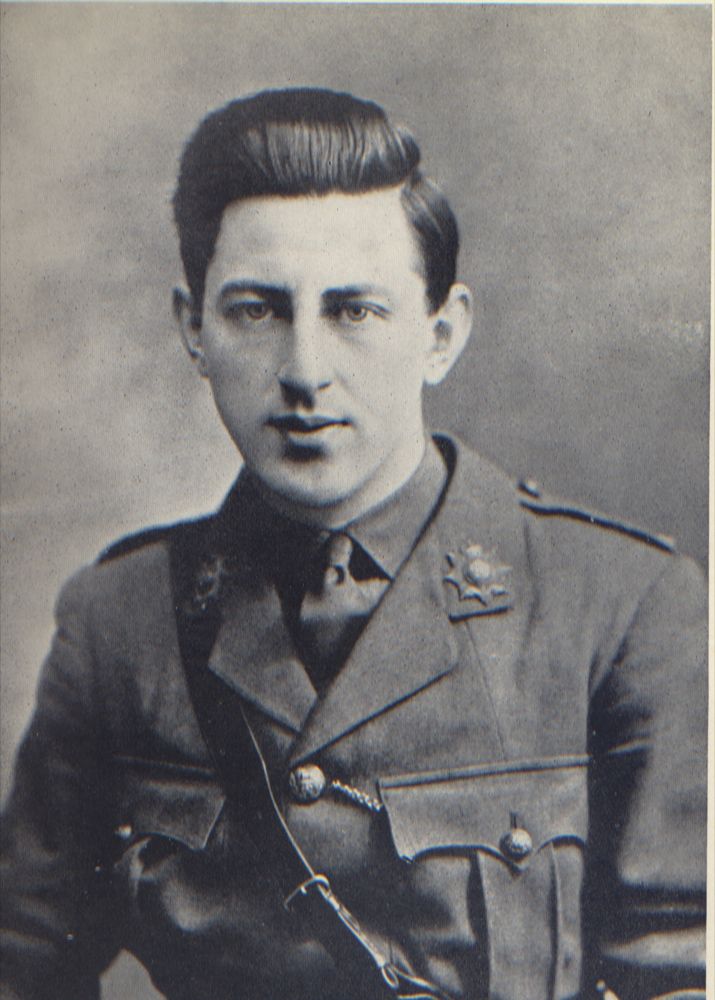
Paul Nash, 1918
'Here in the back garden of the trenches it is amazingly beautiful - the mud is dried to a pinky colour and upon the parapet, and through sandbags even, the green grass pushes up and waves in the breeze... Nearly all the better trees have come out, and the birds sing all day in spite of shells and shrapnel...'

 This opinion was to change dramatically when he returned to Flanders as a war artist in the autumn, and witnessed the aftermath of the Battle of Passchendaele. That he had not fought in the battle was down to a mixture of luck and strength of will. In May, shortly before a Big Push, he had the good fortune to fall into a trench in the dark, injuring himself sufficiently to be invalided home. He had been sending sketches of the front lines home and now he seized the opportunity to persuade the authorities that he should be appointed Official War Artist and sent back to France in that capacity.

Nash had on his side a formidable weapon: the persuasive and determined Margaret. John Buchan, author of 'The Thirty-Nine Steps' and now Minister for Information, acquiesced, and within a few months Nash had risen from the ranks of minor British artists to become a household name. He also, incidentally, secured the release of his brother John from service on the front lines, and the two of them spent much of 1918 painting scenes of devastation in the green hills of the Chilterns, with the British and Canadian governments footing the bill.

Paul Nash, We are Making a New World, 1918
Two decades later he was once again appointed as an Official War Artist, and channeled his passionate hatred of Nazism into a series of memorable paintings. This time around, the selection and appointment of artists was organised by a War Artists Advisory Committee led by Kenneth Clark, the charismatic Director of the National Gallery. He believed that fine artists were an asset to the nation and should be kept from harm, and also that the work of such individualistic painters like Nash could serve as valuable propaganda.

Rex Whistler, dining room at Plas Newydd, 1936-7
However the appointment system was not perfect, and some of the omissions are mystifying. Why, for example, was Rex Whistler not chosen? According to his brother Laurence's biography, Clark approached artists whose work he knew and admired, and invited others to apply. Thomas Hennell was one painter who applied repeatedly, until he was eventually accepted. Whistler was not approached, and could not - out of pride, perhaps - apply.

Laurence wrote of his elder brother that he was 'not of this age', and indeed he does seem a strange, old-fashioned figure, painting murals for aristocratic clients as if he were living in the 18th century rather than the 20th. In 1936 he was commissioned by the Marquess of Anglesey to paint his dining room at Plas Newydd, and duly produced a glorious set of murals that mirror and transform the view of Snowdonia from the opposite windows.

Rex Whistler, Self Portrait, 1940
Yet this was hardly the time to be courting the aristocracy; by the mid-1930s many of the great houses of the land were falling into decay or being taken over by the National Trust (as Plas Newydd would be), as their owners struggled to pay death duties or meet soaring maintenance costs.

It is worth comparing Whistler's career with that of Eric Ravilious. Both became fascinated by mural painting as students, the former at the Slade and the latter at the Royal College of Art, and both launched their careers with murals. This was thanks in good measure to the legendary Henry Tonks (Paul Nash's former teacher), who chose Whistler to decorate the underground dining room at what is now Tate Britain. The success of these murals, which were finished in 1928 and can still be seen today, was the catalyst for the commissioning of the Morley College murals a year later; the success of these made the reputations of Ravilious and Edward Bawden.

The careers of the three artists had certain parallels; Whistler and Bawden both did work for Shell, while Ravilious and Whistler made designs for Wedgwood and all three were prodigious book illustrators. Socially, however, they moved in very different circles, and while Ravilious and Bawden chose to live simply in Essex, Whistler lived the high life, painting portraits of Cecil Beaton and the Sitwells and murals for stately homes.

When the war came, Bawden and Ravilious were among the first wave of artists chosen to record the conflict. By mid-1940 over 200 names had been considered, including Whistler's, which was apparently marked on the official list with a 'No'. His first inclination had been to volunteer for the army and, without a persuasive alternative, he now joined the Welsh Guards and began training as a tank commander.

Lieutenant Whistler (centre) & Cromwell tank crew 1944
Not that he gave up painting - far from it - and while stationed on Salisbury Plain he had the village blacksmith in Codford make him a unique piece of equipment, a metal box wrapped in a groundsheet, in which he kept paints, brushes and small canvases. This was fixed just behind the turret of his Cromwell tank when he rode in it from a landing craft onto the Normandy beach during the D-Day landings.

An artist at war, Whistler painted and sketched many of his fellow soldiers but only saw action once. With his platoon he was driving through the outskirts of Caen when his tank became caught up in wire, then came under machine gun fire. He jumped down and ran to the nearest tank to explain the situation and give orders, but as he started back to his own tank a mortar exploded, killing him instantly. If Kenneth Clark's ambition had been to protect artists from harm then he had, in this instance, failed.


'Paul Nash in Pictures: Landscape and Dream' is available now from the Mainstone Press and all good bookshops.

Tuesday, 25 October 2011

'Paul Nash in Pictures': Wood on the Downs

Paul Nash, Wood on the Downs, 1930 (Aberdeen Art Gallery)

A clump of beeches rises in a sculpted wave over hills that roll and tumble like the sea. Nash loved the ancient uplands, and his paintings of Iron Age hillforts, trackways and sacred sites span a region from the Dorset coast to the northern tip of the Chilterns. It was during a 1924 visit to Ivinghoe Beacon, that great hump of chalk overlooking the Vale of Aylesbury, that he first discovered this wood, describing it as ‘an enchanted place in the hills girdled by wild beech woods, dense and lonely places where you might meet anything from a polecat to a dryad.’
     Today the Ridgeway and Icknield Way paths meet nearby, making this a landmark for long distance ramblers and a destination for daytrippers, but even in the 1920s people were visiting the hills and woods in increasing numbers. A national preoccupation with prehistory had been growing since the Victorian era and, in the aftermath of the Great War, books like H. J. Massingham’s Downland Man (1926) encouraged readers to explore the landscape of the ancient past. As aerial photography offered a new perspective on earthworks and monuments, the rise of motor transport turned sites like Ivinghoe Beacon into tourist attractions.
     ‘Millions of motorists must have passed the place,’ Nash noted wryly when he described this painting, adding ‘It is on the main road on the top of the hill. I have wanted to do something about it for years.’
     The opportunity came in the last month of his annus horribilis [1929], when Jack offered (or was persuaded) to drive him.
     ‘It was a lovely day for the drive,’ Nash remarked, ‘But devilish cold for drawing when we got to the hills…. The woods in the hollow below were crowded with wild pigeons which alternately sailed in the clouds over the tops of the trees or settled in the branches where they sat so thick the woods looked like monstrous orchards bursting into bloom.’
     He sketched directly onto canvas, noting the colours on a separate drawing, then painted the oil in his studio to his own design. One critic found the pleasure to be found in the picture ‘austere’, adding ‘It is a sort of higher mathematics of painting that Mr Nash pursues.’
     We can imagine the artist chuckling over this remark. As a boy he had been set for a career in the Royal Navy, but failed to pass the necessary entrance exams. There were plans to make him an architect, or set him to work in a bank, but the same weakness held him back:
     ‘Although I appeared to possess a good average intelligence,’ he acknowledged. ‘I was extremely deficient in mathematical calculation… Actually I was capable of quite complicated methods of computation to prove my sums. But the answers were fantastically wrong… I have seen mathematical teachers reduced to a sort of awe by my imbecility.’
     Awe of a very different kind is inspired by this painting. Simultaneously abstract, architectural and descriptive, it gives perfect expression to Nash's extraordinary sense of place.

This is an excerpt from 'Paul Nash in Pictures: Landscape and Dream', which will be available in early November from the Mainstone Press. Join us for the official launch at Henry Sotheran's bookshop in Piccadilly, on November 15th (more details here).

Wednesday, 19 October 2011

'Paul Nash in Pictures' - Launch & Events


Exciting news! Henry Sotheran's, the wonderful fine art and antiquarian bookshop in Piccadilly, is hosting the launch of 'Paul Nash in Pictures: Landscape and Dream' on Tuesday 15 November. I'm not sure of the time yet but I imagine it will be early evening - everyone is welcome to come along and I will post full details as they emerge. (It's 6-8pm)

Other events we'll be doing to celebrate the launch of the book:

Blackwells Bookshop in Oxford has invited me to give an illustrated talk on November 24th, which will probably feature Nash and Ravilious. I'll add a link to the publicity info as it becomes available.

On 1st December I'm taking part in a Paul Nash Evening in aid of the St Bride Library off Fleet Street. Alan Powers and Brian Webb are giving talks and so is David Heathcote, author of 'A Shell Eye on Britain'. It may well sell out.

And on 6th December I'm at Foyles in Cabot Circus, Bristol, for a combined Nash/Ravilious extravaganza.

The book itself should be printed, bound and ready to go in the first week of November. Apologies if you've been looking out for it on Amazon - production has taken just a little longer than anticipated. Judging from the proofs, though, it should be gorgeous.

Thursday, 6 October 2011

Paul Nash: Rye, Dymchurch, Iden

Paul Nash, Landscape at Iden 1929 (Tate)

Since I was eight or nine I've pictured the Battle of Hastings on a beach, like the Normandy landings of World War Two in reverse, so it was rather unsettling to drive through leafy hill country to the landlocked town of Battle. I was endeavouring to get from Eastbourne to Rye by as straightforward a route as possible, which turned out to be not very straightforward at all.

Paul Nash, Winchelsea Beach

The plan was to find a campsite near Rye, but at 6 o'clock on a Sunday evening, as I trundled around the backroads north of the town, this was beginning to look rather unlikely. Eventually I stopped south of Appledore at the Ferry Inn, an old pub with a landlord from Chaucer, and they kindly helped me find a site near Winchelsea Beach.

Driving around in the evening sunlight I found myself in Iden, a village I knew from association with Paul Nash and his haunting 'Landscape at Iden'. Perhaps it is because of the painting that the name of the village is so evocative; the name, which for some reason I associate in my mind with the poet Robert Frost, suggests beauty and antiquity and peace on the one hand and, on the other, death. Well, I suppose that is Nash's fault.

Orchard at Iden


The place itself is charming in a straggly sort of way and must have once - without the speeding lorries and vans - been an ideal artist's retreat. Bordered to the west by a huge orchard and to the north by the valley of the Rother, the village feels a bit like an island. The Nashes lived in the mid- to late-1920s in Oxenbridge - a sort of extension to the Iden - in a cottage Nash described as little more than a summer house, and the surrounding country is haunted by his work.

Paul Nash, Landscape, Stone Cliff

It is a varied landscape, with thickly wooded hills, wide valleys and, only a mile or two away, the great expanse of Romney Marsh, which is bounded here and there by steeply sloping hills, and it evidently inspired Nash more than Rye itself. He and Margaret moved to the ancient hilltop town in 1930, after her mother died and her father needed to live with them, and there's a blue plaque on their house at the top of East Street - a rather eccentric house reminiscent of Nash's grave in Langley.

Rye at the time had a small but boisterous colony of artists and writers, notably the authors EF Benson and Radclyffe Hall. Nash became friends with the latter and with her partner Una, Lady Troubridge, whose appalling taste in art he forgave for some reason, and with Edward Burra and the American poet Conrad Aiken.

Rye: an unlikely outpost of Modernism

Aiken once described Nash's 'love of beauty that was oddly both animal and mineral, and could be as soft as a cobweb... or the flesh of a woman, or as hard as one of the flints in his "Nest of Wild Stones"'.

Chez Nash 1930-33

The early 1930s were a tricky time for Nash, however, with a less-than-successful foray into abstraction and considerable soul-searching about his work. Visiting Rye, with its narrow streets isolated from the natural world (Burra, who lived there most of his life, called it Tinkerbell Town) one can understand how his mind became tight and tangled there.

He had got on much better along the coast at Dymchurch where, in the early 1920s, he painted at least two dozen pictures, both in oil and in watercolour.

Paul Nash, The Shore 1923 (Leeds Art Gallery)

What I hadn't realised until I clambered up onto the sea wall to have a look is that he could have painted them all without moving more than a hundred yards or so. Rarely have I visited a place and found it so haunted by a painter.


He himself alluded to a certain therapeutic quality in his Dymchurch work, and one can see how the sheer bulk and wonderful geometry of the sea wall might have helped him to overcome the nervous strain of war.

Paul Nash, The Shore, Dymchurch

An odd little place, Dymchurch must have been, with its handful of grand villas, its humble, pantile-roofed cottages, the marshes stretching away to the north and, looming over everything, the great mass of the wall. Subsequent history has layered amusement arcades and gift shops over the old buildings, but the wall, though recently improved, is still a thing of elegance and grace - modern, functional and as good a symbol of security as you could wish for in unstable times.


Look out for 'Paul Nash in Pictures: Landscape and Dream' - published this month by The Mainstone Press.

To be continued.

Sunday, 31 July 2011

'Paul Nash in Pictures: Landscape and Dream'

Paul Nash, Event on the Downs, 1934-5

Paul Nash in Pictures: Landscape and Dream celebrates the life and work of Paul Nash (1889-1946), an artist of energy and vision who created iconic paintings of both world wars and explored in inimitable style the ideas and issues of the interwar years. After a period of neglect following his death, Nash’s reputation is in the ascendant again, but though we appreciate the quality of his paintings, we have perhaps lost sight of their humanity.

Bringing a fresh eye to the artist’s legacy, Paul Nash in Pictures: Landscape and Dream goes behind the scenes of twenty-two paintings to explore Nash’s life, the places and people he knew, and the times in which he lived. The book draws on diverse sources, from published books to correspondence, to create an intimate portrait of a passionate, funny, supremely imaginative artist.

This approach will be familiar to readers of the Ravilious in Pictures series published by the Mainstone Press, and the book has been produced in a similar style and with the same attention to detail. In this, the first of two proposed books on Nash, we focus on the artist’s oil paintings – the work in which he explored most thoroughly the ideas that preoccupied him. Well-known paintings like ‘The Battle of Britain’ are included alongside pictures that are reproduced for the first time. A second volume will address the artist’s watercolours, so that the two books together form a unique biography of Paul Nash – a life in pictures.

Paul Nash in Pictures: Landscape and Dream will be published by The Mainstone Press in October 2011. James Russell is available for talks and book signings. Please contact the publisher for details.

What the critics say about Ravilious in Pictures:

‘Beautiful’ (Stella magazine, Sunday Telegraph, Dec 2009)
‘Ravilious’s watercolour landscapes of the South Downs … are beautifully reproduced here 
alongside insightful essays…’ (London Review of Books, Jan 2010)
 ‘James Russell’s writing has the clarity and concision of the paintings, and is both properly informative and enjoyably readable... Glorious.’ (Andrew Lambirth, The Art Newspaper, Sept 2010)
‘A vivid portrait of the artist’ (Country Life magazine, Dec 2010)
‘Fantastic’ (Emily Rhodes, The Spectator Arts Blog, Dec 2010)
‘Alluring… convivial…’(Paul Laity, The Guardian, May 2011)

Tuesday, 19 July 2011

James Fox, 'British Masters' & 'Paul Nash in Pictures'

Stanley Spencer, The Resurrection, Cookham, 1926
After an eye-opening first instalment, art lovers around Britain were keen to see what James Fox would get up to in the second episode of 'British Masters', and he didn't disappointment. Lingering shots of a nude Stanley Spencer (did somebody say 'flaccid'?) were followed by a piece proclaiming the virtues of obnoxious Royal Academy president Sir Alfred Munnings. A deeply unfashionable artist, we were told, and it wasn't hard to see why; it was much more difficult to see why Dr Fox had picked him out for special praise.

Until, that is, we reached the finale of that piece, in which an inebriated Munnings launched a public tirade against modern art in general and Picasso in particular. Not for the only time in the programme, the excellent archive footage and recordings had more allure than the art. 'In Search of England' was the title of a book by bestselling interwar travel writer HV Morton (whose 'In Search of London' is still in print and one of the best books EVER on the city), and in the programme Dr Fox used the documentary-travelogue form to great effect.

Nash and Spencer aside, he mostly avoided the famous names of the period and instead chose artists whose work reflected the concerns and conflicts of the age: Munnings and the 'ordinary' William Coldstream stood on two sides of a divide represented in literature by Evelyn Waugh and George Orwell. If this made interesting viewing it didn't necessarily show British art at its best, and Dr Fox will no doubt be lambasted as a reactionary himself - have we had a female artist yet? I don't think so...  However, the day was saved by the in-depth study of Spencer and a fascinating final section on John Piper, whose exquisite painting of Coventry Cathedral, still smouldering after the previous night's bombing, has a genuine, understated greatness.

The film of Piper discussing Gainsborough and Picasso was a curiosity - what a strange old bird he was - and the sequence on the 1936 International Surrealist Exhibition was fun too. I loved the old footage of people travelling by bus to Avebury, although I don't remember reading anywhere that Nash discovered the ancient stones by chance, after suffering an asthma attack on a bus. Is this really what happened?
John Piper, Interior of Coventry Cathedral, 15 November 1940

It would be good to know as I've been delving into Nash's life and work this year in preparation for a new book, 'Paul Nash in Pictures: Landscape and Dream', which will be published by the Mainstone Press in the autumn. As with the 'Ravilious in Pictures' series, the new book focuses on a selection of twenty-two paintings, each accompanied by a concise essay; we've decided to dedicate the first volume to Nash's oil paintings, which he used to express the ideas that pre-occupied him most. A second volume will focus on his gorgeous watercolours, which were admired greatly during his lifetime but which are now rarely seen in public.

Paul Nash, The Wanderer, 1911

The more I learn about Nash the more fascinating a figure he becomes. Born in 1889 he had the kind of Victorian childhood where Mother was seen for an hour in the evening. He read Lewis Carroll and Edward Lear, and from them gained a lifelong love of nonsense and wordplay, and though occasionally ill was robust enough to star in his school soccer team. Any sensible career path was cut off for him by his hopeless maths, yet critics later described his paintings as 'mathematical'. He seems to have been motivated by an intense inner vision, but took centre stage in the public debates of the time.

His struggle to reconcile modernity and Britishness was rather like Piper's. Nash tried abstraction, but quickly returned to the painting of natural forms - stones, leaves and trees. Although he greatly admired (and in some cases knew personally) Picasso, Max Ernst, de Chirico, Magritte and other modern artists, he continued to find inspiration in nature and constantly sought subjects in the British landscape that reflected his inner preoccupations; his discovery of Avebury in the summer of 1933 was part of this quest. His frequent journeys to France, including a hilarious jaunt around the Riviera with a young Edward Burra, were also part of the process.
Paul Nash, Equivalents for the Megaliths, 1935
So, another contentious and gripping programme from James Fox comes to an end, and we must wait a whole week for the next. What on earth will he say, I wonder, about post-war painting?