 |
| Eric Ravilious, Tea at Furlongs, 1939, watercolour |
Hello!

|
| Eric Ravilious, Tea at Furlongs, 1939, watercolour |
 |
| Tirzah Garwood, Erskine Returning at Dawn, 1950, oil on canvas |
So it's been exciting to bring together eighty-plus of these works (along with ten by her first husband, Eric Ravilious) and arrange them in what I hope is a helpful way. I've been wanting to do this for a long time, and in 2018 did bring together Garwood and Ravilious in my exhibition In Relation: Nine Couples who Transformed Modern British Art at RWA Bristol. That experience persuaded me to include a few pertinent wood engravings and watercolours by Ravilious in the first half of the Garwood show; the artists' contrasting approaches to similar motifs are fascinating, and the comparison sheds valuable light on Garwood's creative development.
You'll have an opportunity to get to know Tirzah Garwood a bit better before the exhibition because I'm giving an online lecture on 1 October, which will be recorded and made available to ticket holders for the rest of the month. If you follow the link you should find all the info you need.
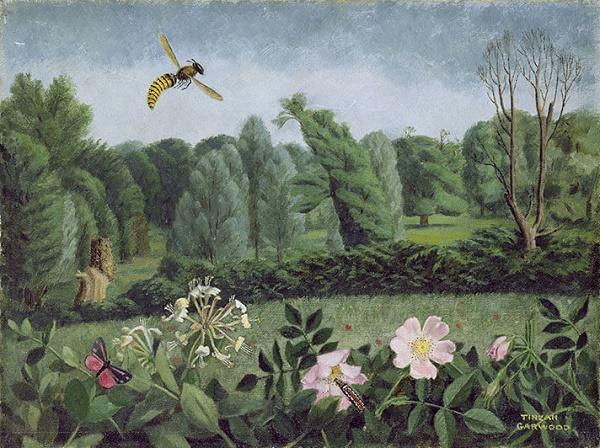 |
| Tirzah Garwood, Hornet and Wild Rose, 1950 (Towner) |
Another lengthy silence and another valid excuse... I've been hard at work putting together the first major museum exhibition devoted to the art of Tirzah Garwood (1908-51) since the memorial exhibition shortly after her death.
Tirzah Garwood: Beyond Ravilious will open at Dulwich Picture Gallery in November, and I am absolutely delighted to be bringing the work of this remarkable artist to the audience she deserves. I was going to say 'unknown' artist but in fact Garwood is familiar to quite a number of people, thanks to her autobiography Long Live Great Bardfield and to Margy Kinmonth's film Eric Ravilious: Drawn to War.
Some of the wood engravings she made in her early twenties are also well-known, having been reproduced here and there, but those were a small - if brilliant - part of her artistic achievement. In the 1930s and 1940s she made exquisite decorative papers using a marbling technique that was all her own and went on, in the few years she had between the end of World War Two and her death from breast cancer, to create a series of compelling house constructions or dioramas and a group of hauntingly beautiful oil paintings.
The last twenty of these Garwood painted in her last year, when she knew she was dying and yet was somehow able to paint works that are at once radiant and uncanny. They are not at all like her first husband's watercolours, but she did share with him an 'innocent eye' that was a lot less innocent than it seemed, and an ability to get to the very essence of things.
Roll on November!
Tirzah Garwood: Beyond Ravilious opens at Dulwich Picture Gallery in November, almost ten years after my exhibition Ravilious opened there. I'll be advertising an online lecture to introduce the show soon...
 | |
| Eric Ravilious, New Year Snow, 1938, watercolour |
I wrote the note below for Dreweatts, who were selling New Year Snow in their recent auction, Robert Kime: The Personal Collection...
This atmospheric watercolour depicts a picturesque valley in the Welsh borders and, at the same time, shows us a master at work.
Early in 1938 Ravilious travelled to Capel-y-Ffin, a hamlet in the Honddu valley not far from the ruins of Llanthony Priory. Having concentrated on illustration and design for a couple of years he was at last free to paint watercolours, and to take his time doing so. He had booked a room in the hamlet’s solitary farmhouse for two months, and looked forward to exploring a landscape that was wilder than his native Sussex.
Steeped as he was in the English watercolour tradition, Ravilious was well aware that JMW Turner, John Sell Cotman and other luminaries had painted the valley before him, although those earlier Romantic artists had tended to focus on the ruined abbey. A more recent visitor was artist-poet David Jones, who had stayed with Eric Gill and his entourage in Capel-y-Ffin in the 1920s. Ravilious admired the strong modern line and delicate palette of Jones’s watercolours, which present subjects similar to this but in a very different style.
In New Year Snow Ravilious presented a recognisable view south-east along the valley, towards the distinctive buttress of Loxidge Tump. He was no topographer, however, and here he redirected the course of the river so that it bends across the composition, roughly mirroring the curve of hills against the sky. Water, land and sky are painted with remarkable economy, with only the lightest of washes across the hilltops. Mostly the watercolour has been applied in single strokes, often with a dry brush. The white paper showing through suggests here rough grass dusted with snow and there the shimmer of moving water, while conveying at the same time a feeling of light-heartedness and freedom.
In place of the ruins beloved of Turner’s generation, we have the kind of man-made object that delighted Ravilious: a sheep feeder on wheels set centre stage and at a precarious angle. This positioning and the clarity of the draughtsmanship lend a slightly dreamlike quality to the scene.
In May 1939 Ravilious held his third exhibition of watercolours at the prestigious London gallery of Arthur Tooth and Son, the show that cemented his reputation. In The Observer, Jan Gordon praised Ravilious’s extraordinary technique, which made the most mundane object ‘appear as something magic, almost mystic, distilled out of the ordinary everyday.’ Twenty-seven watercolours are listed in the catalogue; New Year Snow is No. 1.
I can't remember the exact figure, but the work ended up selling for over £300,000... New Year Snow is featured in my book Ravilious in Pictures: A Travelling Artist, published by The Mainstone Press.
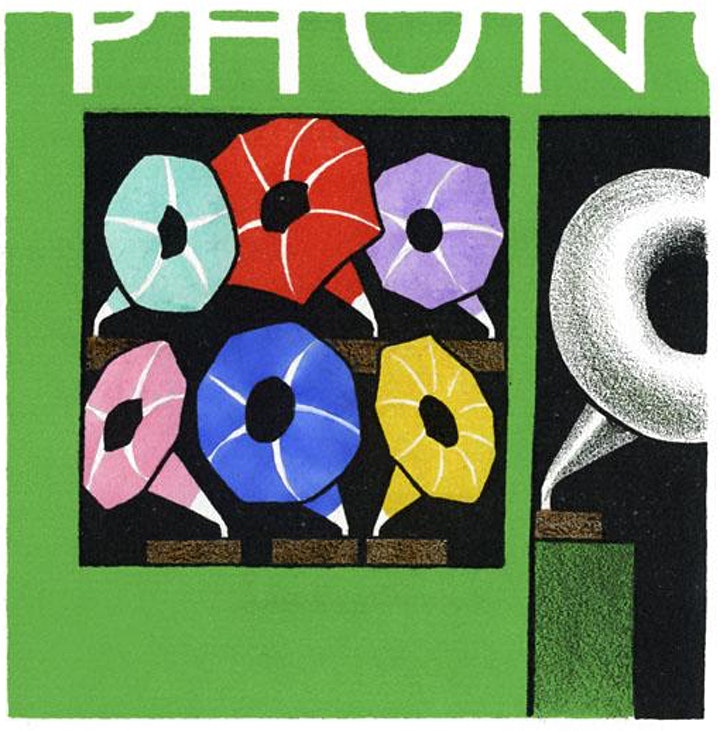 |
| 'Gramophones', from Boutiques, illustrated by Lucien Boucher |
Each book takes as its starting point an innovative illustrated book of shops published in Paris in the 1920s: Boutiques (1925) and Boutiques de la Foire (1926), with colour lithographs by Lucien Boucher, and Boutiques Litteraires, with illustrations by Henri Guilac (1925). Each Mainstone edition features captions by Andrew Stewart and an array of historical photos, archive materials and artworks brought together in typically elegant, witty style by designers Webb & Webb. Literary flaneuse Lauren Elkin wrote an accompanying essay for the Guilac book, while fairground historian Pascal Jacob did the same for Boutiques de la Foire and I wrote on the first Boucher book. Print aficionado Neil Philip provided for each volume a succinct print and production history.
To me, these books are primarily guides for the time-travelling armchair flaneur: books to marvel at and dream in. It's important to note, however, just how little has been written about the supremely talented Boucher before now, in any language. Most of the material I drew on in my essay (with help from my A-level French) was unearthed by Tim Mainstone, who made it is his mission to discover every known fact, story or piece of gossip about this brilliant precursor to Eric Ravilious and Edward Bawden. In fact Tim spent years trawling obscure databases and publications for information not only about Boucher but also about publisher Marcel Seheur and - last, but definitely not least - the brilliant author Pierre Mac Orlan, whose waspish prose poems add a strange, dark mystery to the original book. They are included in the new edition, alongside translations by Shaun Whiteside.
Tim has published some wonderful books over the past two decades, but I'm not sure anything compares in scope, ambition and sheer wonderment to the Boutiques trilogy. If you'd like to see this work of art for yourself and hear a bit more about how it was created, come along on the 12th. You're in for a treat.
 |
| Eric Ravilious, Pilot Boat, 1939 |
A few years ago I wrote the following to accompany the illustration of Pilot Boat in Ravilious in Pictures: A Travelling Artist. As usual Tim Mainstone and I spent a long time pondering which works to include in the book - a process you certainly wouldn't describe as painful - eventually picking this one as an atmospheric depiction of a French Channel port on the eve of war. In many instances we can revisit the sites of Ravilious watercolours and find them unchanged, but not in this case...
If Ravilious painted an interior scene on a painting trip you can be sure that the weather made working outdoors impossible. Le Havre was so cold he could only work outside for short periods, so it was as well that he had picked a hotel in such a good location, just 100 yards from the Quai George V. He was first captivated by the sleek lines and yellow masts of a steam yacht belonging to the Rothschild family - ‘the most elegant boat I ever saw’ - but, as he reported, ‘there are splendid boats wherever you go, and striped and red buoys and a special green water, a grassy green’.
Ordinary people were fascinated to see an artist at work but, with the French newspapers dominated by discussion of the imminent conflict, Ravilious was treated with suspicion by officials who perhaps took him for a spy. ‘A gendarme questioned me closely,’ he reported on one occasion, ‘but retired beaten by my Pigeon French.’ Within a year Ravilious would be questioned far more aggressively by armed British servicemen as he drew port scenes in his capacity of war artist.
For the people of Le Havre the anticipated Nazi invasion was swift. On June 13 1940, as thousands of Allied troops evacuated by sea, German forces entered the city, where they remained in occupation for the next four years. During this time the garrison turned France’s second largest port into a massive fortress, and this spelled disaster for the city when Allied forces landed in Normandy in June 1944. Beginning on 5th September RAF bombers and naval guns blasted the city, reducing the centre to rubble and filling the waterways with wrecks. The port Edward Wadsworth had known for 30 years, and which he described in correspondence with Ravilious as ‘a real gold mine of matter’, was destroyed.
The return of peace brought to Le Havre the renowned architect and town planner Auguste Perret, who set about building a new city over the ruins of the old, using modern materials with panache in a 20-year project of unparalleled ambition. Indeed, it has been recognised as such by UNESCO, which in 2005 designated the rebuilt port a World Heritage Site. As a reminder of the old port we have this painting, almost a winter version of Seurat’s luminous harbour scenes, with a similar spaciousness and even the same mooring posts. In the low sunlight the clean lines of the pilot boat stand out against a background that seems almost on the point of melting away, with ghostly figures dimly perceptible on the far side of the water the only sign of life.
A fine marine study, the painting is also filled with foreboding; ‘I shall be surprised,’ he wrote on returning home, ‘If there isn’t a war by the middle of May and drawing and all other sensible things fade into the background, though Tooth’s assure me their business will carry on as usual.’
This is an extract from Ravilious in Pictures: A Travelling Artist (Mainstone Press).
Pilot Boat is Lot 12 in Sotheby's auction of Modern British & Irish Art, which will be held on 23 November. You can view the lots between 18-23 Nov.
I'll be talking about Place in Modern British Art with Frances Christie and Simon Martin at 1pm on Sunday 20 Nov.
Well it's less than a minute long, but I think this is a great introduction to my exhibition Seafaring, which runs at Hastings Contemporary until the autumn. Made by Ali Jassim - who can find on Instagram as @just_jassim - the film follows two young visitors as they tour the exhibition, stopping to look at an array of works by artists such as Cecily Brown, Eric Ravilious and Maggi Hambling.
Seafaring runs until 25 September: you can find out all about the show here.

I'm very much looking forward to discussing 'Eric Ravilious: Drawn to War' with the film's director Margy Kinmonth, on Weds 6 July. Since we've talked about the film a lot over the past few years we thought it would be fun to have a fairly informal chat about the making of the film, with some behind-the-scenes pictures and discussion of our favourite Ravilious works.
We're actually doing a live Q&A at the Watershed in Bristol, but I think that has already sold out. In fact this is happening a lot with Margy's live appearances, so all the more reason for an online event.
So if you've seen the film and have a question for the director, or you want to find out more before booking your ticket, do join us. The event will be on zoom, with a recording available for a week afterwards. Info and tickets via Eventbrite. Hope to see you there!
 |
| Eric Ravilious, Submarine Commander Looking Through a Periscope, lithograph, 1940-41 |
I'm sure you've had the experience of watching the film version of a novel you love... and wishing you hadn't. It took me years to see The English Patient, so powerful was my own impression of the story, and I've still never seen The Great Gatsby on screen. I don't know if there's a film of Ulysses or To the Lighthouse out there, but if there is I would sell the telly to avoid watching them. On-screen voices and images tend to overwhelm our own more fragile, imagined versions of character and setting, which in some instances are as precious as real memories.
Having spent much of the last fifteen years building up my own impressions of Eric Ravilious and his world, I was apprehensive about seeing Eric Ravilious: Drawn to War. I knew it would get the story 'right', because Margy Kinmonth is a brilliant, diligent film-maker who involved ER's daughter (and expert fact-checker) Anne Ullmann throughout. But that's not really the point, is it? I've read all of ER's letters many times. They have a voice in my head, as do his wife Tirzah Garwood's letters and autobiography. I also have my own interpretation of the Ravilious story, one I have recounted to many thousands of people over the past decade and a half. Margy's version was bound to be different - how would I feel as it unfolded on the screen?
I needn't have worried. The first scene plunges us into a world of mingled sadness, beauty and joy. Pace and tone are spot on. Voices and images come and go, held lightly together by Edmund Joliffe's marvellous score - music I could imagine ER whistling as he worked. Watercolours, wood engravings and lithographs appear before us, hover for a moment or two, then fade away. The voices of Eric (Freddie Fox) and Tirzah (Tamsin Greig) convey the brightness - in all senses - of the characters. There are familiar faces - Anne herself, ER's grand-daughter Ella Ravilious, Grayson Perry, Alan Bennett - and one or two I wasn't expecting. Ai Weiwei's interjections are memorable. Anne Desmet is fantastic on wood engraving.
We see hands at work, cutting into wood blocks or painting, and these clips take on their own rhythm, flowing through the film. They help build up our picture of Ravilious the artist, and at the same time they add to the poetic structure of the film. It's a documentary, yes, but also a kind of evocation. The film reflects its subject not only in content but also in structure and style. ER's work in all media has this hard-to-define quality of blended rigour and lightness, and in its clarity and effortless flow the film captures this perfectly.
I can't wait for the London premiere on 27 June!
A little later, on 13 July, I'll be joining director Margy Kinmonth for a Q&A plus screening at the Watershed, Bristol. This is one of numerous Q&As Margy will be doing around the country. Meanwhile the film will be showing at 60 cinemas nationwide, starting 1 July. Info here. Read more about the film here.
The private view of the 2015 Ravilious exhibition at Dulwich Picture Gallery was a bit of a blur, but one moment that stuck in my mind was meeting Margy Kinmonth for the first time. I had really enjoyed her film about LS Lowry, and when she appeared out of the crowd that evening and said she was making a film about Ravilious I was intrigued.
Not long after that we met up and had a chat about the project, and since then we've kept in touch. As far as I can tell she has talked to everyone who has anything remotely helpful or interesting to say about Ravilious, and she has overcome innumerable obstacles to get her film made. After hearing so much about the film over so many years I can't quite believe I'm going to see it in a couple of weeks...
Eric Ravilious: Drawn to War is produced by Foxtrot Films and distributed in UK cinemas from 1 July by Dartmouth Films: find your local screening here!
 |
| Richard Eurich, Survivors from a Torpedoed Ship, 1942, Tate |
From fishermen to submariners, migrants to merchant seamen, people throughout the ages have shared the experience of being at sea. Seafaring explores the perils and pleasures of life at sea, while at the same time taking visitors on an art historical voyage from the early 19th century to the present.
At the heart of the exhibition is Lost at Sea, a show-within-a-show featuring three oil paintings by innovative contemporary artist Cecily Brown from her critically-acclaimed Shipwreck series. These are set alongside works by three Romantic artists who inspired her. Eugène Delacroix, Théodore Géricault and J.M.W Turner were among the first painters to focus attention on the plight of shipwrecked mariners, ordinary people who found themselves at the mercy of the sea. Géricault’s painting The Raft of the Medusa inspired another contemporary artist, Martin Kippenberger, to explore his own mortality in a set of lithographs.
The themes of shipwreck and rescue also play out across the wider Seafaring exhibition, as do those of voyage and migration, work and leisure, war and peace. The exhibition includes works based on artists’ observation of the sea and the creatures that inhabit it, and depictions of the people who, for different reasons, travel the sea by ship or boat. In the late 19th century James Tissot studied travellers embarking and disembarking at the Port of London, while Edward Burne-Jones painted a poignant portrait of a young wife longing for the safe return of her husband from sea. Early in the next, Frank Brangwyn portrayed trawlermen battling rough seas. World War Two gave artists such as Ronald Searle and Edward Ardizzone the opportunity to observe maritime life at first hand. Eric Ravilious briefly became the unofficial artist-in-residence aboard a training submarine. More recently Peter de Francia and Maggi Hambling have explored very different aspects of migration by sea, while Chris Orr offers a light-hearted view on life aboard an ocean liner that complements the elegant posters of the interwar years.
Seafaring opens at Hastings Contemporary on Saturday 30 April!
 |
| A Ravilious Coronation Mug features in this linocut by Angie Lewin |
I'm looking forward to joining artist and designer Angie Lewin on March 23 for an online event exploring her career-long fascination for Eric Ravilious. With Kirsty Rodda of Hampshire Cultural Trust keeping us in order, we will spend an hour looking in-depth at Rav's achievements in wood engraving, watercolour and ceramic design. I always enjoy hearing other people's views on artists I admire, doubly so when the views are coming from someone as talented and insightful as Angie.
We will have some slides to share so you can see what we're referring to, but this is definitely a conversation rather than a lecture: we're bound to end up venturing down some unexpected avenues!
If you'd like to join us please visit The Arc Winchester website for details and tickets.

Eric Ravilious: Downland Man is on 2nd December, via zoom, hosted by the Wiltshire Museum. Tickets and information are available on the museum's website.
The chalk downland of southern England inspired Eric Ravilious (1903-42) to produce some of his finest watercolours, but his fascination for the Downs ran deeper. Until January 2022 Wiltshire Museum is hosting Eric Ravilious: Downland Man, the first exhibition to explore the relationship between an extraordinary artist and designer, and the landscape he loved. In this wide-ranging online lecture curator I'll be introducing the themes of the exhibition and looking in-depth at The Westbury Horse and similar treasures, some well-known, others rarely seen.

To celebrate the forthcoming publication of the new Mainstone Press edition of Boutiques, I will be delving into the life and career of French artist and illustrator Lucien Boucher. Published in 1925, Boucher's colourful survey of Parisian shops is one of the most remarkable books of this time, and a major influence on Edward Bawden and Eric Ravilious. As well as exploring Boucher's marvellous illustrations we'll be taking a virtual tour around the Paris he knew and loved, so if you fancy some pre-Christmas flaneurism, do book a ticket!
 |
| Front cover, catalogue of Eric Ravilious: Downland Man exhibition |
Almost a decade after Wiltshire Museum director David Dawson suggested the idea, Eric Ravilious: Downland Man is set to open at said venue on 25 September. Having been forced to delay the exhibition by a year because of Covid I'm excited to be hanging the show this month, especially as there are one or two works I haven't seen for a very long time.
The catalogue has been sent to the printers by designer Lucy Morton of Illuminati Books, who designed the 2015 Dulwich catalogue and has created another gem for this show. It will be available in the museum shop and on their website. My essay explores the artist's relationship with the chalk hills of southern England, putting his passion for the landscape in historical context. The 1920s and 1930s saw a great upsurge of interest in the Downs and their history, encouraged by archaeological discoveries at Stonehenge, Avebury and Maiden Castle, where Mortimer Wheeler's excavations were funded by public subscription.
Downland Man is the title of a 1926 book by philosophically-minded countryside writer HJ Massingham. It was also a title mooted by publisher Noel Carrington for the Puffin Picture Book of chalk figures and other monuments that Ravilious planned to create; the dummy for this book was won at auction by David Dawson in 2012 (on behalf of the museum). It is from the acquisition of this humble but emotionally-charged object that the exhibition grew.
Of course Ravilious had a personal relationship with the chalk hills that began with his boyhood move from London to Eastbourne, and was still going strong when he explored coastal defences at Dover the year before he died in 1942. It was, in his interpretation, a human landscape, scarred and furrowed, and lived-in.
Eric Ravilious: Downland Man opens on 25 September 2021 at the Wiltshire Museum, Devizes. Please book via the website before you go.
I'm giving a lecture on 5 October for the Friends of the South Downs exploring the themes of the exhibition with a particular focus on the region of the national park, entitled Eric Ravilious and the South Downs. It will be via Zoom and booking is open now on the Friends' website.
 |
| Eric Ravilious, Mackerel Sky, 1938, private collection |
This radiant watercolour was for many years thought to be missing, when it was in fact hanging quietly in a collector’s home. Like many of his contemporaries Ravilious was intrigued by ‘nautical style’, as John Piper put it, and often turned his gaze to lighthouses, boats and bathing machines. Here he contrasts the familiar shapes of fishing vessels with softly undulating mud. Hawsers and stays snake in and out of the picture, framing a distant wreck. Is this a reminder of mortality, or simply an interesting object that caught his eye?
Mackerel Sky will be on show for the first time since 1939 at Hastings Contemporary, May 27 to Oct 30 2021, as part of my wide-ranging exhibition Seaside Modern: Art and Life on the Beach.
Greetings! With everything being so grim at the moment I thought I would put together a short series of lectures on Eric Ravilious. These will take the form of three live webinars, which will then be available as recordings to ticket holders who can't make the actual event.
I gave my first lecture on Ravilious in 2008 to coincide with the publication of The Story of High Street (Mainstone Press). Since then I have written the four books in the Ravilious in Pictures trilogy (yes, really), curated the 2015 Ravilious exhibition at Dulwich Picture Gallery and lectured on this fascinating artist to audiences across the country. I love the fact that his watercolours and designs are both enjoyable and serious, light-hearted yet powerful, dream-like but rooted in reality.
 |
| Eric Ravilious, Waterwheel, watercolour, 1934 |
First up, on February 9, is Eric Ravilious: Art and Life - a colourful introduction to the life and work of the celebrated artist and designer:
Eric Ravilious was only 39 when he died on active service as a war artist in 1942, yet he had already achieved amazing things. A brilliant wood engraver and designer, he is best known today for his haunting watercolours in which lighthouses, white horses, empty rooms and downland paths become marvels. This entertaining illustrated talk illuminates the life and work of a playful, enigmatic artist.
 |
| Eric Ravilious, Letter Maker from 'High Street', lithograph, 1938 |
On February 16 we turn our attention to Eric Ravilious: Design - a lively survey of a scinitillating career, exploring wood engravings, book illustrations and designs for Wedgwood:
During his short life Eric Ravilious (1903-42) was acknowledged as a brilliant wood engraver, lithographer and creator of ceramic designs for Wedgwood. This lecture follows the trajectory of a sparkling career, offering insights into his influences and technique while celebrating his greatest achievements. Look out for familiar favourites, from the wood engraving used on the cover of ‘Wisden’ to the lithographs featured in ‘High Street’, his 1938 book of shops, and the Alphabet design Ravilious created for Wedgwood.
 |
| Eric Ravilious, Newt Pond, watercolour, 1932 |
Over the past decade Eric Ravilious (1903-42) has become recognised as one of the finest artists of his generation, yet he remains an elusive figure who made little if any public comment on his work. Based on years of research, this lecture explores the artists's achievements in depth, looking closely at some famous favourites and revealing hidden treasures. Whether you're a die-hard fan or have recently discovered Ravilious, there's plenty to enjoy.

 |
| Eric Ravilious, Scrubbing Brush and Soap, 1915 |
 |
| Eric Ravilious, Cliffs in March, 1939 (lost) |
 |
| Eric Ravilious, The Wilmington Giant, 1939 |
 |
| Eric Ravilious, The Yellow Funnel, 1939 |

 |
| Eric Ravilious, Rye Harbour, 1938 (Ingram Collection) |
