Showing posts with label Southampton City Art Gallery. Show all posts

Monday, 21 July 2014

A Modern British Summer!

Paul & John Nash reunited at RWA Bristol
For a long time the auction houses and dealers have been enjoying a boom in Mod Brit, as 20th century British art is known in the trade. Or rather, as 20th century British painting, sculpture and artist-made design is known.

For those baffled by artspeak, there's a world of difference between 'modern', which now refers to a period from about 1910 to the beginning of the Saatchi era, and 'contemporary', which refers to art being made now - or some of it, at least. For art to be 'contemporary' it generally needs to be non-traditional, as 'modern' art used to be. Nowadays Edward Seago is 'modern', and you don't get much more traditional than him.

JD Fergusson, Bathers: Noon, 1937, (c) The Fergusson Gallery
Of course some Mod Brit artists really were modern. Take JD Fergusson, the Scottish painter who immersed himself in the vibrant visual culture of early 20th century Paris and brought home a wild palette and a boundless zest for life. One of the world's great colourists, he has remained popular since his death in 1963 - but neglected south of the border. Now, however, Pallant House is offering English fans an opportunity to revisit Fergusson's work, as curator Simon Martin explained to me recently.

'Over the past few years,' he told me, 'Pallant House Gallery has carved a niche in presenting reappraisals of overlooked British artists and themes.

'The JD Fergusson exhibition has come to us from the Scottish National Galleries and is very timely as it the first solo museum show of this Scottish Colourist in England for over forty years, and demonstrates the important point that British artists were not working in a vacuum, but working in continental Europe as part of the international avant-garde.'

Great exhibition, great catalogue...
Simon made a name for himself a few years ago with a brilliant exhibition devoted to another overlooked British artist, Edward Burra - a painter of extraordinary originality and verve - and since then Pallant House has become one of several out-of-London museums catering to the renewed interest in all things Modern and British.

Dulwich is only just out of London, but the need for visitors to leave the West End and venture onto the rail network does make Dulwich Picture Gallery a not-quite-London venue. Famous for its gorgeous permanent collection, DPG has also embraced Mod Brit following the startling success in 2010 of 'Paul Nash: The Elements', David Fraser Jenkins' memorable exhibition.


Until 21 September you can enjoy 'Art and Life', a delightful exhibition devoted to the work of Ben and Winifred Nicholson, Christopher Wood and others, in an environment ideally suited to the pictures. These artists, like many of their generation, painted on a relatively modest scale, and the work feels at home in the intimate exhibition gallery at Dulwich. I enjoyed seeing the exhibition at Kettle's Yard, but the paintings come to life in a different way in their current home - worth taking the ten-minute train ride from Victoria to see them again!

Closer to home (for me, at any rate), and close to my heart, is the new RWA exhibition devoted to the careers of Paul and John Nash. I have spent a lot of time over the past few years writing about, thinking about, and generally going on about Paul Nash, and I wish there weren't so many books about him so I could write another one. Oh well.

Paul Nash, Dymchurch, c1922-4, Dudley Museums Service, (c) Tate
A few years ago I had the idea of celebrating the centenary of the Nash brothers' first (and only) joint exhibition, which took place in 1913. I approached the RWA, with whom I had worked on an exhibition of Ravilious watercolours, and they decided to include 'Brothers in Art' as part of their impressive Great War centenary programme. I've been too busy elsewhere to get involved, but curator Gemma Brace has put together a mouth-watering selection of pictures by both artists, including one of the nation's favourite paintings, John's 'Cornfield'.

Like many smaller institutions the RWA is handicapped by the prohibitive charges levied by larger museums and estates for reproduction rights, making it very difficult for them to promote the exhibition nationally, but I hope that word spreads around the grapevine. There are pre-Great War paintings by both artists that have rarely, if ever, been shown publicly before, along with later pictures that are justly celebrated. From Paul a lovely oil of Dymchurch and 'Eclipse of the Sunflower', from John languid views of Bath and the eye-of-God vision of 'Gloucestershire Landscape'.

Almost my favourite picture on public display anywhere in Britain right now is Paul Nash's early watercolour of elm trees in the blue summer dusk, which is featured in the exhibition.

Meanwhile, in another part of the country... we have Towner's wonderful Peggy Angus show, which is full of surprises. When Sara Cooper and I were planning the exhibition we faced a particular challenge in the varied nature of Peggy's career. On the surface, at least, her paintings are very different from her tile designs, and what about her long and distinguished teaching career? How on earth do you represent years in the classroom in a museum show?

As it turned out, her fabulous wallpaper (hand-printed for us by her grand-daughter Emma Gibson) offered a way of pulling the disparate aspects of her career together - as well as causing a lot of jaws to drop. Besides, these different sides of her life were not actually so different. Look for instance at the curving line of the railway in one of her paintings of Asham Cement Works, and then at the undulating design in her Lansbury tile mural, and you can see the same hand behind them. Similarly, the design work she did in the classroom relates closely to her commercial work. Thanks in part to Towner's moveable walls, the exhibition flows nicely, showing us different sides of a single, inspiring, creative mind.
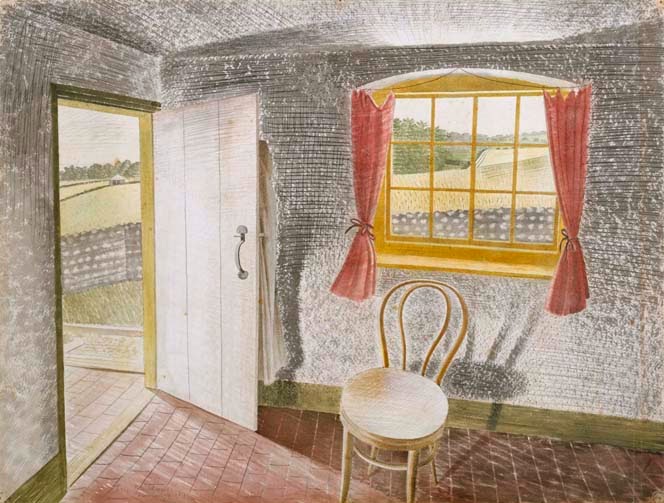
Eric Ravilious, Interior at Furlongs, 1939, Towner

Peggy Angus, The Three Bears, c1945, (c) Estate of Peggy Angus/DACS
We thought a great deal about whether to include Ravilious paintings in the exhibition and decided they were so immediately relevant - given the artists' friendship and shared artistic interests - that it would be crazy not to. Although Ravilious was the superior painter overall, I don't think Peggy's pictures of the cement works, or of Furlongs, suffer by comparison.

Rather, his 'Interior at Furlongs' and her paintings of the same subject complement one another, while the fantastic stage set of the famous table and chairs is a must-see for any true Ravilious devotee. There is even an oil lamp on show that he bought for Peggy from a Lewes junk shop.

In part I think the growing fascination with all things Mod and Brit has a lot to do with our distance from those days, especially the 1930s. You have to be of a fairly decent age now to remember the decade with any clarity, and for those born in wartime or afterwards it has the same air of mystery and nostalgia that the Victorian period had for their parents. For young artists and designers, meanwhile, Peggy Angus must come as something of a revelation - a talented maverick who enjoyed not one but several careers, leaving behind an extraordinary body of work.

FFI:
JD Fergusson at Pallant House
Art and Life at Dulwich Picture Gallery
Brothers in Art: Paul and John Nash at RWA Bristol
Peggy Angus: Designer, Teacher, Painter at Towner


Also playing:

From David Bomberg to Paula Rego: The London Group in Southampton at Southampton City Art Gallery - a century old this year, having been set up on the eve of the Great War to help artists who were shunned by the Establishment, the London Group is still going strong today. It describes itself as 'a thriving democratic co-operative of artists practicing in all disciplines, from painting and sculpture to moving image and performance, with a full annual events programme in London and beyond.'

Keith Vaughan at the Fry Art Gallery, Saffron Walden - an exhibition 'specially devised to reflect the influence of north west Essex on Vaughan by showing 'Essex work'. Vaughan enjoyed relaxing in the Essex countryside where he could explore the constant changes in the natural world and the open sky as a contrast to his life in London. He was also interested in the juxtaposition of geometric shapes provided by vernacular architecture. Many of his later paintings can be traced back to photographs that he took in Essex whilst living at Harrow Hill.'

Kenneth Clark - Looking for Civilisation at Tate Britain

Apologies if I've missed out something obvious - please add a comment!


Monday, 22 April 2013

To Chichester by Choo-choo

RB Kitaj, The Rise of Fascism, 1979-80 (Tate/Artist's Estate)
Last Thursday I went to Chichester on the train, a journey that combined beautiful scenery with various human irritations. Did the conductors (there were two on the same train) have to be quite so aggressive in their ticket-checking? Was the woman sitting behind me trying to get into the Guinness Book of Records for the longest monologue about the minutiae of a person's everyday life? 

The train went via Bath and Bradford-on-Avon to Warminster, Salisbury and Southampton, crossing a region that roughly equates both to old Wessex and to Southern Command during World War II. Just beyond Warminster we passed an army depot with rows of heavily armoured, desert-brown vehicles, the austere hills of Salisbury Plain rising behind. We trundled along the Wylye Valley and through Wilton, where two artistically minded generals, Auchinleck and Alexander, held the post of Commander-in-Chief, Southern Command, one after another.


Their Camouflage Officer was Edward Seago, painter, inventor of a new concealment material made from horsehair and subsequently a life-long friend of both men.  I wonder whether he was involved with the crazy scheme to camouflage chalk railway cuttings by spraying them with black ink, an experiment Eric Ravilious was invited to record but which was abandoned too soon for him to do so.

Paul Delvaux, A Siren in Full Moonlight, 1940 (Southampton City Art Gallery)
The spire of Salisbury Cathedral reminded me of two other artists, Rex and Laurence Whistler, the former killed in action in Normandy, the latter responsible for his beautiful memorial in etched glass which you can see in the cathedral. When we reached Southampton I braved a gale to visit the City Art Gallery in the fabulous 1930s Civic Centre, and found some lovely things on display. A Delvaux mermaid stole the scene in the main room, while a moody painting of a forest by Elizabeth Magill showed that the Romantic tradition in British landscape painting is alive and well.

Chichester Cathedral - peregrine falcons nest in top right turret
I also had a look at Paul Nash's painting 'The Archer', which still seems a bit contrived but has a haunting quality shared by the material on display at my final destination, the Pallant House Gallery in Chichester. While Southampton seems to have been constructed by a giant armed with children's building blocks, central Chichester retains its 18th century or even Medieval scale. When Daniel Defoe visited he noted that the city's population could easily fit into the cathedral, and that may well still be true. 

'What will survive of us is love' - The Arundel Tomb
Unusually for a British church, the cathedral doubles as an art gallery, with a painting by Graham Sutherland standing on the altar in one chapel, while elsewhere a stained glass window by Chagall casts a ruby glow on the stone floor and gigantic tapestries dazzle the choir. There are glorious medieval reliefs carved in stone, Philip Larkin's favourite tomb and even a Roman mosaic; few churches can give one such a strong sense of continuous human history - something the vandals of the Reformation didn't think too much about.

Graham Sutherland, Noli me Tangere, 1960
But the cathedral was an added bonus. My real reason for coming to Chichester was to talk about Paul Nash at Pallant House, a gallery that, like Kettle's Yard in Cambridge, champions 20th century British painting and sculpture. The main collection inhabits a characterful 18th century house with small, well-proportioned rooms that might have been designed to show the kind of art on display. A couple are currently filled with Barbara Hepworth's hospital drawings, but otherwise this is a treasure trove of pictures by neglected artists.

Pallant House

Where else would you see a painting by Frances Hodgkins, the New Zealander who was one of Britain's best-known modern artists in the early 1940s? Where, outside Kettle's Yard, might you find pictures by Ben and Winifred Nicholson side by side, so that the similarity between the two is obvious? Christopher Wood is there too, and Alfred Wallis, and Ivon Hitchens, and the Nash brothers. At the end of my talk someone kindly pointed out to me that there was an Eileen Agar self-portrait in an upstairs room.

The main attraction just now is an RB Kitaj retrospective, which you can read all about here. I think I enjoyed most the more straightforward pastel drawings, which show both wonderful draughtsmanship and a disquieting sense of character and atmosphere.


Paul Nash, by Clare Neilson (Pallant)
But I was there because of Paul Nash and his patron and friend Clare Neilson. Her collection of his books, letters and photographs was recently given to Pallant House, and is currently on display. If you're a Nash fan you have to see this. This isn't a curator or critic's interpretation of Nash's career but an intimate portrait of the artist; alongside wood engravings, illustrations and books - 'Places', 'Room and Book' and others - are hand-written letters and photos, stuck to pages from faded albums, showing him playfully posing with standing stones. 

This is the artist I was looking for when I researched 'Paul Nash in Pictures: Landscape and Dream', and it was a treat to see him brought to life in this beautifully presented exhibition.

FFI: Pallant House Gallery