|
| The Family Butcher |
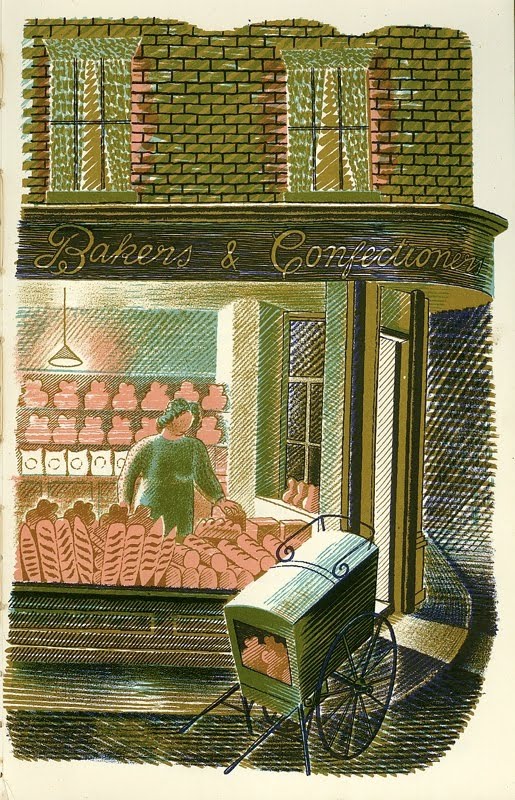
If you're interested in the history of the British high street, you might enjoy this extract from 'Eric Ravilious: The Story of High Street', which was published in 2008 by The Mainstone Press.
My contribution to the book was an essay based on a quest undertaken by Tim Mainstone and I, to find each of the 24 shops depicted by Ravilious in his 1938 book 'High Street'. We wanted to know whether the shops were still there and, if not, what had happened to the business and the building itself...
You'll find my essays on two of the shops in Part Two, here.
This essay began as a mission to track down the shops but, as material began to accumulate and information emerged, it became apparent that this exercise in social history was developing in unexpected ways. Each shop has its unique history as a building, a business premises and a business, and each history involves families and individuals whose lives are in many cases otherwise undocumented. Research into 1930s Castle Hedingham (the artist's Essex home) conjured shopkeepers out of the buildings where they once conducted their business – people like Bennett Smith, the ceiling of whose hardware shop was hung with chamber pots. Working back from the present incarnation of Castle Hedingham, with its general store and tea room, we can reanimate the village the artist looked on as he worked.
 |
| Castle Hedingham site of the Butcher's Shop |
Other discoveries have opened unexpected avenues and offered valuable insights into artist and work. A number of photographs have come to light, showing the real shops on which the High Street illustrations were based, and some of these photos show startling discrepancies between reality and art. Seeking documentary evidence to confirm the identity of a shop, we found instead evidence of artistic licence, which seems to have found its fullest expression around Sudbury and the Hedinghams. Why is this? How, we might wonder, was Ravilious inspired by the village itself, with its idiosyncratic mix of medieval, early modern and Victorian architecture, and its fanciful plasterwork?
Of the 24 shops depicted, the Clerical Outfitter (Wippell’s) and the Cheesemonger (Paxton and Whitfield) are still trading from the same premises, but what of the others? The publication of High Street in 1938 seems to set it at the end of a pre-war golden age, and one might expect to discover shops destroyed by bombing or put out of business by the more subtle effects of World War II. Yet, as Richards makes clear, change was already altering the appearance of the high street when the book was published, and this is confirmed by an observant chronicler of London life in the mid 1930s, Thomas Burke.
 |
| The shop in 2007 - it's changed again since |
Contrasting the pre-war years to those of his youth at the turn of the century, he noted the transformation of small shops into large stores, with a corresponding loss of character and distinctiveness.
He writes of, “Provision-merchants selling sporting equipment; gramophone makers selling refrigerators; tobacconists selling cutlery; cutlers selling foreign stamps; greengrocers selling butter and eggs, and bookshops selling gramophone records.”
Looking back, Burke makes an unfavourable comparison between contemporary retailers and the shopkeepers of his youth:
“In the past, shopkeepers knew their own minds and minded their own business. They described themselves on their shop-fronts in terms of definition. The butcher was a ‘purveyor of meat.’ The greengrocer was a ‘pea and potato salesman.’ The man who sold hats was a hatter and it was useless to ask him for overcoats or skis.”
Historian Dorothy Davis describes the role of this old-fashioned shopkeeper in more detail: “Grocers had to understand how to choose, blend and grind as well as weigh and package much of their stock. Even haberdashers bought cotton and thread by the pound and disentangled it and folded it into hanks for sale…
“Every trade,” she continues, “Needed its own knowledge and skill.”
 |
| The Public House |
This is the world Ravilious set out to explore in High Street, a world of defined spaces and roles that was already falling apart when the book was published. With the development of manufactured or semi-prepared goods, and with the spread of advertising, the modern shopkeeper found himself dealing in products that were not only made and packaged but also, in effect, sold beyond the walls of his shop. In this environment there was no reason for a retailer to specialise, hence the diversification noted by Burke, and the accompanying loss of distinctiveness. What he notices in particular is the disappearance of olfactory stimuli.
“The store has one large and nondescript smell,” he writes, “But when I think of shopping I think of each separate shop and its separate smell. There was the smell of the draper's shop; the smell of the chemist's; the smell of the grocer's; the smell of the pastrycook's - what a smell! - the smell of the oil-and-colourman's… You could range the gamut of the human nose from pungent to mawkish.”
We are now so unused to shops having a smell that it comes as shock when, walking into a shop like Paxton and Whitfield, our nostrils are assailed more powerfully than our eyes. The supermarket environment is visually stimulating but odourless, with smells suppressed by refrigeration and plastic packaging, and the same is true of the DIY store, with its pungent products sealed into branded containers. For a child, the experience of shopping must be far less intense than it was twenty years ago, let alone seventy. True, there are some shops that retain their atmosphere: the shoe shop still has a leathery aroma, and the secondhand bookshop its dust; the weary smell of the charity shop might even be new to Ravilious and Burke. However, the greater thrust is towards uniformity and ever-higher economies of scale.
In the Foreword to High Street Jim Richards argues that, “It is no use regretting the coming of the multiple store and the standardization of shop fronts, as these… make better goods available to more people.”
 |
| The Public House today - recognise it?! |
The logic of this attitude, played out over the subsequent decades, has brought us to a crisis point. In 2004 2,157 independent shops either went out of business or became part of a larger company, compared to a previous average of around 300 per year. Our love of convenience and low prices has given us the great supermarket chains, but as the giants tighten their grip we begin to see that shopping is about more than price and efficiency. As we drive down the high street we despair that charity shops and fast food joints have taken the place of butcher’s and baker’s, greengrocer’s and boutiques selling ladies’ fashions.
Yet some independent retailers have survived. Look at the hardware store, which started out as the ironmonger’s, trading in raw materials like lamp black and brick dust, and which then evolved with changes in production and demand. Some traders transferred their allegiance to the new labour-saving devices, like washing-machines, while others responded to the explosion of interest in home decoration and gardening that accompanied interwar suburban expansion. The 1930s saw a huge increase in multiple stores specialising in decorating supplies – the ancestors of today’s DIY superstores – but on many high streets the general hardware store adapted and survived. Among the old, independent retail businesses that persist in twenty-first century Soho are venerable hardware stores like Gould, Hopkins and Purvis, which have so far withstood rising rates and rents.
 |
| Shopping in the old days |
Meanwhile, concern over loss of distinctiveness in the retail world has given us several recent books, whose authors share Ravilious’s love of the idiosyncratic. In Still Open: the Guide to Traditional London Shops, Sally Venables highlights a selection of businesses that might have been included in High Street, suggesting that this vision of the English shop persists today. Indeed, the success of internet-based retail operations like eBay has encouraged the growth of a new generation of specialist shops funded by the proceeds of online businesses, niche outlets that double as storage facilities for the internet trade.
The specialist, whether selling cheese or stuffed animals, still has an important role to play, and in London particularly whole streets of independent businesses continue to prosper. Consider Jermyn Street, home of Paxton and Whitfield, which can claim among its famous shops Taylor of Old Bond Street (gentlemen’s hairdressers and purveyors of toiletries), Floris (a perfumery dating from 1730) and Bates the Hatters, the latter still overseen by Binks, the stray cat who wandered into the shop in 1921.
Jermyn Street is of course unusual. On most streets dramatic changes have occurred since 1938, and this tour of High Street at seventy will show how a particular set of twenty-four shops, divided between London, Suffolk and Essex, has fared in the intervening years.
 |
| A Soho hardware store |
Each shop is a gateway that will lead us into a new realm of historical, biographical or artistic discovery. In part this process of exploration is a kind of game, a treasure hunt in which we follow the clues left by artist, writer and friends, to try and piece together not only a historical record but also a more private story that brings together places and characters that are otherwise unconnected. High Street is not just a book of shops, after all, but also a kind of autobiography: a portrait of one man’s geography of pleasure.