Showing posts with label RWA. Show all posts

Monday, 22 June 2015

Summer at the RWA, feat. James Ravilious

James Ravilious, Archie Parkhouse & his dog Sally, copyright Beaford Arts
Exhibition launches at the Royal West of England Academy in Bristol are always fun, partly because the building is so impressive and the staff so cheerful, but mostly because the work on display is so varied. This time around there are three exhibitions, linked by a broad theme but otherwise remarkably diverse.

This being Bristol's year of being European Green Capital the three exhibitions are united by the artists' shared interest in nature and our relationship with the natural world.

In the main room, with its wonderful high ceiling and natural light, are gigantic works on paper by Peter Randall-Page RWA and (as of last week) RA, across which flow great tributaries, or family trees, or neural pathways in brown or black ink. Pattern and order on the one hand, freedom on the other, combining to give an impression of organic systems.

One work forms a screen, behind which lurk other, rather different forms. Actually some of these are beautiful, while others recall Surrealist fantasies of creatures alarmingly combined. It would really spoil the surprise if I described them. Suffice to say, Kate MccGwire must spend an awful lot of time collecting feathers, while the installation of her gorgeous-but-monstrous creations is surely a logistical nightmare.

James Ravilious, John Bennett, traveller, copyright Beaford Arts
In a way the world of James Ravilious is equally strange. No fantasy here, mind you. His photographs, taken in the last quarter of the last century, represent real places and real people, all (as far as I remember) in rural North Devon. The strangeness is found partly in the subject matter, a hands-on country life far removed from modern urban existence, and partly in the photography itself.

Although he chose photography over drawing or painting, James shared important qualities with his father Eric (who died, it should be noted, when he was only three), such as clarity of focus, a powerful sense of structure and a willingness to work with the sun in his eyes. Here and there one can see the influence of Edwin Smith, whom James got to know through Peggy Angus, but most of the work is unmistakeably, charismatically his.

One of Eric's less well known skills lay in making friends with people - the owners of greenhouses or abandoned lighthouses, patrons, etc - and in his decades taking photographs for the Beaford Archive James demonstrated an even greater sociability. Rather than snap people anonymously he got to know them, often very well, so that they trusted him and were themselves in front of his camera. Go and have a look, and if you know anyone who is studying photography tell them they HAVE to go.

Laura Knight, Spring, 1916-20, Tate
Finally, through the heavy door and into the climate-controlled rooms, where paintings from (or loosely associated with) the Newlyn School are on display. Instead of fishing boats and bays here are fields, farms and working people, the same kind of people portrayed by James Ravilious but romanticised somewhat. The colours throughout are fresh, the mood generally light, with the freshest, lightest painting of all being Laura Knight's effervescent 'Spring'.


Monday, 30 January 2012

Ravilious Watercolours on Show in March!

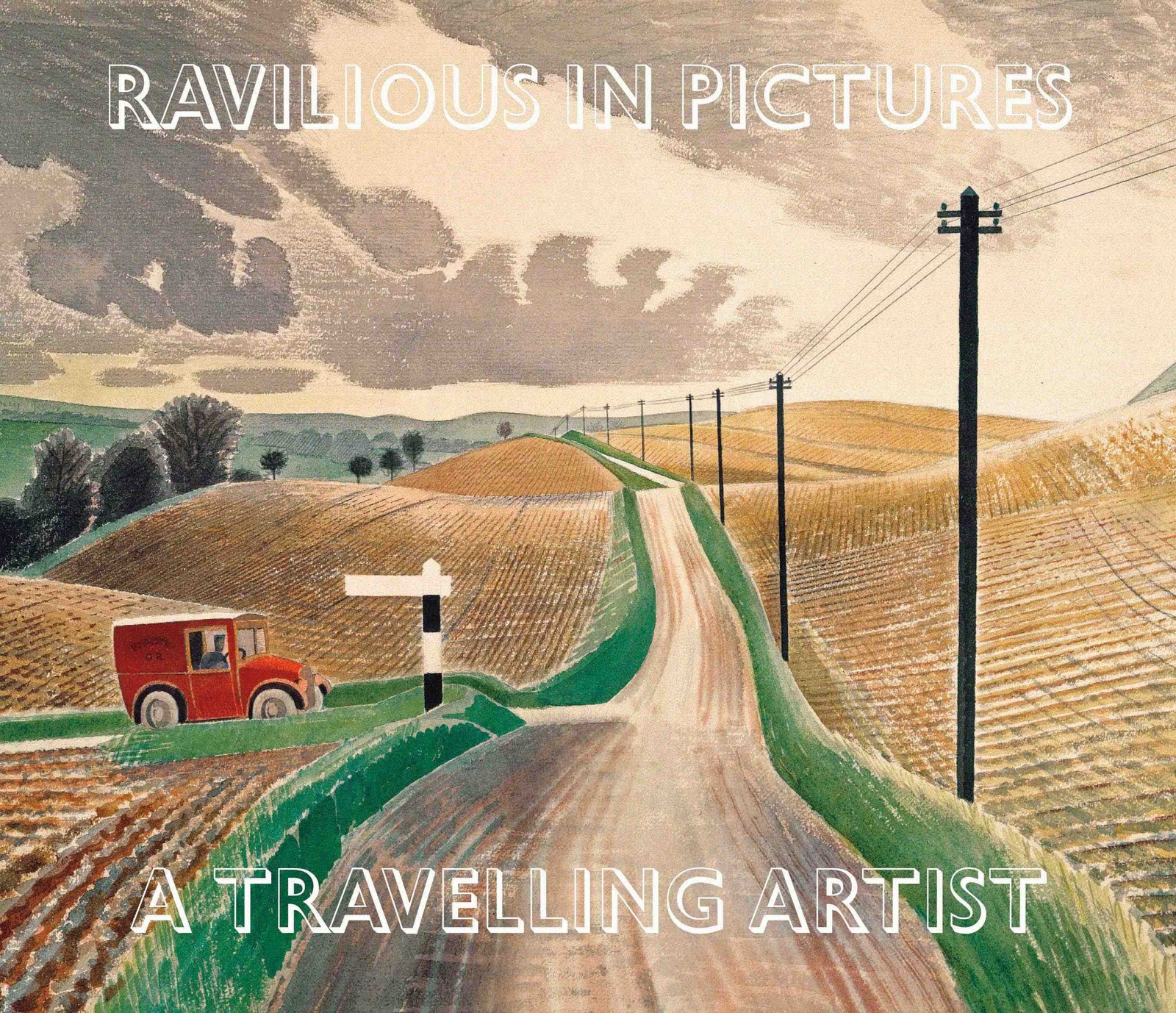
We'll be launching the new book at the RWA, Bristol, on Saturday 10 March!
Exciting news for art lovers in the West Country! On 10 March an exhibition of watercolours, wood engravings and lithographs by Eric Ravilious (1903-42) will open at the Royal West of England Academy here in Bristol.

After the phenomenal success of Ravilious shows in Eastbourne (Towner, 2010) and Saffron Walden (Fry Art Gallery, 2011), it will be wonderful to see a substantial body of work on display in the West of England. I haven't seen a full list of pictures yet, but there will definitely be some favourites on show, alongside paintings that people may not have seen before.

from Ladies Who Travel
At the Towner exhibition, 'Familiar Visions', we saw the artist's paintings of Sussex alongside his son James Ravilious's photographs of Devon. The Fry also took a regional angle, concentrating on 'Ravilious in Essex'. This time around the organisers are taking a slightly more academic approach, using the title 'Going Modern/Being British' as a starting point. It was Paul Nash, the painter's teacher, who asked in the early 1930s whether it was possible to be a modern artist while retaining qualities he considered to be traditionally British. In paintings like 'Event on the Downs' he tackled this question head on, but he'd already addressed it in more subtle ways earlier in his life.

He was particularly influential in the 1920s as a champion of wood engraving and watercolour. These were in no sense new media, but they had been so neglected in the 19th century that they must have seemed fresh and exciting to young artists in the aftermath of the Great War. Nash's 1924 exhibition of landscapes in watercolour was a dazzling success, but with most of the pictures in private hands it is difficult for us to appreciate just how good - and how innovative - this work was.

We are much luckier with Ravilious, who was studying with Nash at the time and went on to master both of his teacher's favourite media. As a wood engraver he was rarely surpassed - a fact that was acknowledged during his lifetime - but as a watercolourist the very good reputation he had built up before his death is only now recovering from a long period of neglect. It's wonderful that so many of his paintings have survived, in excellent condition, and that so many are either in public collections or owned by people who are more than willing to lend them for exhibitions.

Eric Ravilious, Interior at Furlongs, 1939 (DACS)
Ravilious is often described as 'quintessentially English' rather than British, a distinction which I think makes him seem a slightly parochial figure - as does his lack of interest in artistic movements and theories. In fact he numbered Henry Moore and other modernist luminaries among his friends, and travelled as widely as circumstances allowed; he painted ordinary things - an old car, a greenhouse, a barbed wire fence - in a way that made people see them in a new light, which suggests a modern mind at work.

David Hockney, Winter Timber
I'm glad this show will be on at the same time as David Hockney's exhibition at the Royal Academy. The two exhibitions will prove a wonderful study in contrast, with giant, boldly coloured pictures on the one hand, and small, delicately-nuanced paintings on the other - brass band vs solo violin. Yet the two artists also have so much in common, in particular a vital understanding that mystery and beauty reside in the most ordinary scenes.

Eric Ravilious: Going Modern/Being British is at the RWA, Bristol, from 10 March until 29 April
David Hockney: A Bigger Picture is at the RA, London, until 9 April

We will be launching 'Ravilious in Pictures: A Travelling Artist' at the RWA, Bristol, on 10 March, and on 24 March I will be giving an illustrated talk based on my researches for the new book, also at the RWA.

Friday, 8 July 2011

Mary Fedden at the RWA

Mary Fedden, Fruit Dish, 1992

These are strange times at the Royal West of England Academy, an institution which has traditionally served the region's artists with a genteel lack of concern for footfall or fashion. With the appointment of a new director, Trystan Hawkins, the old dowager has been given a thorough makeover, with a cafe installed where the New Gallery used to be and a summer exhibition designed to pull in the crowds and - judging by the merchandise on offer - part them from their cash.

There's a giant Damien Hirst sculpture of a 1960s Spastics Society collecting box on the balcony and an exhibition, combining behind-the-scenes photographs and paintings, of professional ballroom dancers. The paintings are by Jack Vettriano, who is 'arguably one of the country's most popular living artists', according to the exhibition flyer. The photos, by Jeanette Jones, capture the tension, excitement  and fear of a tough competitive world; the paintings offer a less emotionally intense, more glamorous vision.

Mary Fedden, Window Still Life, 1994
The president of the RWA, Simon Quadrat, has recently resigned in protest at the populist programming, and you can see his point. The director's response is that people will come to see Hirst and Vettriano and, having paid their £5, will have a look at paintings by Lisa Milroy, sculpture and works on paper by Elisabeth Frink, and a mini-retrospective of Mary Fedden.

There are three gorgeous etchings made by Frink in the 1970s, but I really came to see Fedden, an RA and former president of the RWA who is now in her nineties and still painting. She was born in Bristol during World War One and, after studying at the Slade, returned to paint and teach here. The Second World War and marriage to Julian Trevelyan took her away from the city, and today she lives beside the Thames in London.

Mary Fedden, Red Tulips, 2010
The Portland Gallery in London held a major retrospective of her career a couple of years ago, but the RWA show is different. For one thing, it has the great virtue of being small. While a big show can be a lot of fun I think I prefer a one-room exhibit; rather than rush from picture to picture, trying to take them all in, you can relax, focus on one or two favourite paintings, and compare work easily. It's fascinating to see a still life painted in the early 1950s (and perhaps in need of a clean) beside one made in the 1990s.

There are some intimate details - a watercolour of an elephant painted for a friend - but most of the work is of a familiar kind: still lifes of fruit and flowers and jugs, with perhaps the view from a window beyond, also some landscapes. What one tends to lose when looking at reproductions, apart from the texture of the paint, are the subtle variations in colour that add so much to the feeling of a painting. There really is no substitute for seeing a painting live...

Perhaps the next stage in the 'Your Paintings' scheme should be for participating museums and galleries to put on a whole host of one-room shows - not massive, expensive affairs but small, manageable exhibitions. Look what 'Ravilious in Essex' has done for the Fry Art Gallery and tourism in Saffron Walden (3000 extra visitors in a couple of months). Many other artists have a dedicated hard core of fans who would willingly travel for a small, well-thought-out, show.

Mary Fedden, Lilies, Bird and Zebra, 1999
The pictures shown are from the database of Mary Fedden's work at the Portland Gallery, London, which represents her.

You can see photos of the work hanging at the RWA here (scroll down a bit)...