Showing posts with label Fry Art Gallery. Show all posts

Wednesday, 22 May 2019

Symposium - An Outbreak of Talent


Paul Nash photographed by Lance Sieveking, 1924

“Ten years ago I was teaching at the Royal College of Art. I was fortunate to be there during an outbreak of talent, and can remember at least eight men and women who have made names for themselves since then in a variety of different directions; in Painting, Edward Burra; Applied Design, Edward Bawden, Barnett Freedman, and Eric Ravilious; Textiles, Enid Marx; Pottery, Bradon (sic), also William Chappel in Stage Design and Barbara Ker-Seymer in Photography.” 

Paul Nash writing in Signature magazine, November 1935 

Paul Nash only taught part-time at the Royal College of Art during the academic year 1924/25, but he greatly influenced the careers of some of those whom he mentored. In this Symposium we hope to find out what it was that Nash found in these young artists which caused him him to single them out ten years later.

I'll be talking about Eric Ravilious and Edward Bawden... The Symposium is being run by the Fry Art Gallery, but it will be held at Murray Edwards College, Cambridge on 6 July 2019 - info and booking form on the Fry website.

Monday, 25 April 2016

Wednesday, 23 September 2015

Help the Fry Art Gallery buy its Building!

Eric Ravilious, Two Women in a Garden, 1932
The Fry Art Gallery in Saffron Walden is one of my favourite art museums, being small, mildly eccentric and full of work by artists I like. Visiting from Bristol poses a logistical challenge or two, but it's always worth the effort. I was there for the launch of the 'Ravilious in Essex' show a few years ago, and what an entertaining day that turned out to be. On those occasions you can be sure to meet some interesting people and hear a tale or two.

Anyway, the Fry has been going sicne 1985 and now its custodians have the opportunity to buy the lease - correction, freehold! - of the building, which was built in the mid-19th century to house the art collection of Quaker businessman Francis Gibson - it still seems like a private gallery, but one to which we're all invited. Success in its fundraising mission would mean that the Fry's valuable role as first port of call for students and admirers of the Great Bardfield artists is assured for posterity.

In case you're wondering who the aforementioned artists are, they include Eric and Tirzah Ravilious (or Tirzah Garwood), Edward Bawden, John Aldridge, Kenneth Rowntree and the Cheeses, Bernard and daughter Chloe. For a full list, why not have a look at the Fry's website? You will also notice, tucked away at the bottom of the Home Page - how typical of the gallery to ask for money so discreetly - a mydonate button.

And you have until October 25th to visit the Fry's 30th anniversary exhibition, which features work by numerous artists with a Bardfield connection, from Rav and Bawden to Grayson Perry. Have a look and see what Martin Gayford thought of the show...

Thursday, 16 April 2015

Ravilious in Pictures: Iron Bridge at Ewenbridge

Eric Ravilious, Iron Bridge at Ewenbridge, 1941-2, Fry Art Gallery

Beneath bare winter branches a bridge leads across a stream to open country beyond. For a rural footbridge this is an impressive structure, with iron railings and posts supported by elegant iron hoops, but on closer inspection it appears that the bridge was built not for human traffic but for sheep. The ground in front of the bridge is well worn, the hill beyond ideal for grazing. The name too is suggestive. Charles Strachey recalls that his family always referred to the farm as Ewenbridge and, despite a lack of hard evidence, believes that the site may mark an ancestral crossing place for livestock.

This was one of several watercolours Ravilious painted in lieu of rent (to Labour politician and author John Strachey); it is unlikely that we would have any pictures of Ironbridge – or, for that matter, any non-war related paintings from this period – if the arrangement had not been in place. And this is an exquisite piece, one that celebrates good, everyday design and workmanship while inviting an imaginative response. A fairytale troll might live beneath this bridge; a pilgrim might cross to the other side. The elegant ironwork suggests a faith in the power of good design to carry us safely into the future.

In September 1942, only months after completing this painting, Ravilious was reported missing off the coast of Iceland. Still weak from surgery, Tirzah now found the government reluctant to pay either her late husband’s outstanding salary or her widow’s pension. She was forced to argue her case repeatedly, until she finally received the money owed to her a year later and was able to concentrate on the business of living. She began painting in oils, and in 1946 married BBC man Henry Swanzy. However, her cancer returned and she died in March 1951, with Anne not quite 10 years old.

Here the story takes a twist in keeping with Ravilious’s optimistic nature. With the upheavals of the war, their old Hedingham friend Kay Goodden had parted from her first husband Robert, and by coincidence married Henry Swanzy’s brother John. On Tirzah’s death Kay and John took the Ravilious children in, and gave them a stable and happy home.

This future lay ahead, unseen, as Ravilious sketched the bridge. He was at Ironbridge on and off during the summer, as the farm became idyllic once again. In June he reported, ‘The river here looks lovely and I bathed today. The old man Brown who keeps the boats wears a battered old Panama and stinging vermilion football jersey in these grey green willows.’

He came and went, returning for the last time in August to find the children waiting. ‘The Baffy (James) and Anne were at Overall’s corner when I returned…’ he wrote, ‘James chasing a cat and Anne laughing with joy to see her Father.’

This is an excerpt from 'Ravilious in Pictures: A Country Life', published by The Mainstone Press.

Tuesday, 17 March 2015

New Exhibitions: Pallant House, Fry, RWA, Ashmolean & Dulwich

Leon Underwood, The Matchbox, 1930 (private collection)
April may be the cruellest month to a poet of melancholy disposition, but for art lovers it brings treats a-plenty, this year more than most. I was selling my wares at the Nadfas Directory Day yesterday and someone mentioned the exhibition of Great British Drawings which is about to open at the Ashmolean. Having visited the print room a few times I am looking forward to this survey of the collection very much. We tend to see only the oil paintings held by museums, but in many cases the drawings, watercolours and other works on paper are as good, if not better.

Visiting a print room is particularly fun, because as you gently lift each carefully conserved drawing out of a box you have no idea what you will find underneath. One Cotman watercolour of the interior of Norwich Cathedral was particularly striking, the bold colour testament to the quality of the care lavished on the painting over the years.

Like a music festival, the exhibition has some big names topping the bill; we are promised Turner, Hockney, Rossetti, Ravilious, Gainsborough and more. I'm sure Ravilious would be amused (and impressed) to find himself sandwiched between Rossetti and Gainsborough.

Whether by chance or by design, drawing is also the theme of a major spring exhibition at RWA Bristol, where fifty-five works on paper from the Ingram Collection are going on show alongside the annual open exhibition, Drawn. The Ingram Collection has a vast holding of Modern British Art, and this selection, dubbed Drawing On, promises work by Edward Burra, John Nash, Barbara Hepworth and sundry other stars of the period.

Weirdly, there's a Ravilious connection with our next exhibition, Leon Underwood at Pallant House Gallery, since Underwood was teaching at the Royal College when Rav was studying there. Apparently, Underwood liked to invite the most promising students for evening get-togethers, and the Boy was one of those so invited, along with Barbara Hepworth and Henry Moore.

Underwood is one of those figures whose influence was probably far greater than we realise. A multi-talented artist and inspiring teacher, he explored wood engraving, sculpture and painting, creating memorable, innovative work in each medium. Travels to Mexico gave him a global perspective that was relatively rare among British artists of the time.

Kenneth Rowntree, Coronation lithograph, 1953
If Underwood exerted an influence on Ravilious, Kenneth Rowntree worked (at first) in a clear-sighted way similar to Rav and Bawden. Twelve years their junior he was fortunate to grow up during a golden age of British landscape painting, but less fortunate to see its glory fade after World War II. I can't help but see the giant, decorative ER he lithographed for the Coronation in 1953 as a tribute to Eric, but perhaps I'm being fanciful.

The centenary exhibition at the Fry Art Gallery is a collaboration with Liss Llewellyn Fine Art, a gallery that has done more than most to promote 20th century British art. If you haven't done so before, you should have a look at their website, which offers an ever-changing array of paintings, drawings and prints by artists familiar and obscure.

Kenneth Rowntree, Toy Boat at Selsey, 1956 (Fry Art Gallery, Artfunded)
Rowntree has his fans but deserves wider recognition for his upbeat but strangely haunting paintings of landscapes, buildings, boats and interiors. I have a copy of the King Penguin book, 'A Prospect of Wales', and his illustrations are a treat.

Meanwhile, in another part of the country... We're hanging the Ravilious show at Dulwich next week and the excitement levels are mounting. The catalogue is back from the printers and looking great - you can pre-order from Philip Wilson Publishers or from good bookshops like Much Ado Books, Hatchards or Toppings...

Monday, 21 July 2014

A Modern British Summer!

Paul & John Nash reunited at RWA Bristol
For a long time the auction houses and dealers have been enjoying a boom in Mod Brit, as 20th century British art is known in the trade. Or rather, as 20th century British painting, sculpture and artist-made design is known.

For those baffled by artspeak, there's a world of difference between 'modern', which now refers to a period from about 1910 to the beginning of the Saatchi era, and 'contemporary', which refers to art being made now - or some of it, at least. For art to be 'contemporary' it generally needs to be non-traditional, as 'modern' art used to be. Nowadays Edward Seago is 'modern', and you don't get much more traditional than him.

JD Fergusson, Bathers: Noon, 1937, (c) The Fergusson Gallery
Of course some Mod Brit artists really were modern. Take JD Fergusson, the Scottish painter who immersed himself in the vibrant visual culture of early 20th century Paris and brought home a wild palette and a boundless zest for life. One of the world's great colourists, he has remained popular since his death in 1963 - but neglected south of the border. Now, however, Pallant House is offering English fans an opportunity to revisit Fergusson's work, as curator Simon Martin explained to me recently.

'Over the past few years,' he told me, 'Pallant House Gallery has carved a niche in presenting reappraisals of overlooked British artists and themes.

'The JD Fergusson exhibition has come to us from the Scottish National Galleries and is very timely as it the first solo museum show of this Scottish Colourist in England for over forty years, and demonstrates the important point that British artists were not working in a vacuum, but working in continental Europe as part of the international avant-garde.'

Great exhibition, great catalogue...
Simon made a name for himself a few years ago with a brilliant exhibition devoted to another overlooked British artist, Edward Burra - a painter of extraordinary originality and verve - and since then Pallant House has become one of several out-of-London museums catering to the renewed interest in all things Modern and British.

Dulwich is only just out of London, but the need for visitors to leave the West End and venture onto the rail network does make Dulwich Picture Gallery a not-quite-London venue. Famous for its gorgeous permanent collection, DPG has also embraced Mod Brit following the startling success in 2010 of 'Paul Nash: The Elements', David Fraser Jenkins' memorable exhibition.


Until 21 September you can enjoy 'Art and Life', a delightful exhibition devoted to the work of Ben and Winifred Nicholson, Christopher Wood and others, in an environment ideally suited to the pictures. These artists, like many of their generation, painted on a relatively modest scale, and the work feels at home in the intimate exhibition gallery at Dulwich. I enjoyed seeing the exhibition at Kettle's Yard, but the paintings come to life in a different way in their current home - worth taking the ten-minute train ride from Victoria to see them again!

Closer to home (for me, at any rate), and close to my heart, is the new RWA exhibition devoted to the careers of Paul and John Nash. I have spent a lot of time over the past few years writing about, thinking about, and generally going on about Paul Nash, and I wish there weren't so many books about him so I could write another one. Oh well.

Paul Nash, Dymchurch, c1922-4, Dudley Museums Service, (c) Tate
A few years ago I had the idea of celebrating the centenary of the Nash brothers' first (and only) joint exhibition, which took place in 1913. I approached the RWA, with whom I had worked on an exhibition of Ravilious watercolours, and they decided to include 'Brothers in Art' as part of their impressive Great War centenary programme. I've been too busy elsewhere to get involved, but curator Gemma Brace has put together a mouth-watering selection of pictures by both artists, including one of the nation's favourite paintings, John's 'Cornfield'.

Like many smaller institutions the RWA is handicapped by the prohibitive charges levied by larger museums and estates for reproduction rights, making it very difficult for them to promote the exhibition nationally, but I hope that word spreads around the grapevine. There are pre-Great War paintings by both artists that have rarely, if ever, been shown publicly before, along with later pictures that are justly celebrated. From Paul a lovely oil of Dymchurch and 'Eclipse of the Sunflower', from John languid views of Bath and the eye-of-God vision of 'Gloucestershire Landscape'.

Almost my favourite picture on public display anywhere in Britain right now is Paul Nash's early watercolour of elm trees in the blue summer dusk, which is featured in the exhibition.

Meanwhile, in another part of the country... we have Towner's wonderful Peggy Angus show, which is full of surprises. When Sara Cooper and I were planning the exhibition we faced a particular challenge in the varied nature of Peggy's career. On the surface, at least, her paintings are very different from her tile designs, and what about her long and distinguished teaching career? How on earth do you represent years in the classroom in a museum show?

As it turned out, her fabulous wallpaper (hand-printed for us by her grand-daughter Emma Gibson) offered a way of pulling the disparate aspects of her career together - as well as causing a lot of jaws to drop. Besides, these different sides of her life were not actually so different. Look for instance at the curving line of the railway in one of her paintings of Asham Cement Works, and then at the undulating design in her Lansbury tile mural, and you can see the same hand behind them. Similarly, the design work she did in the classroom relates closely to her commercial work. Thanks in part to Towner's moveable walls, the exhibition flows nicely, showing us different sides of a single, inspiring, creative mind.
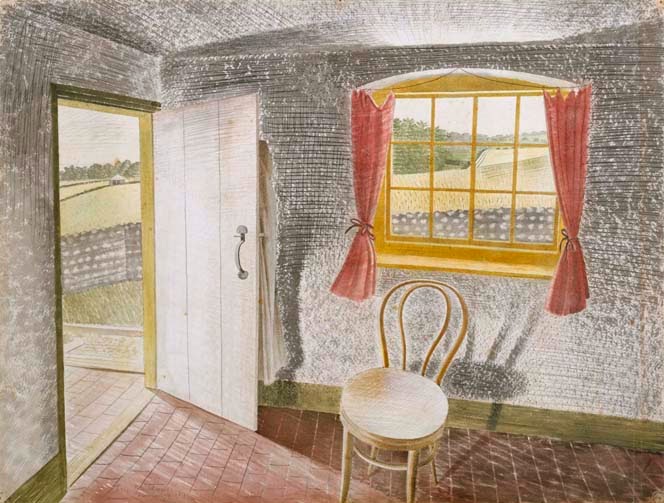
Eric Ravilious, Interior at Furlongs, 1939, Towner

Peggy Angus, The Three Bears, c1945, (c) Estate of Peggy Angus/DACS
We thought a great deal about whether to include Ravilious paintings in the exhibition and decided they were so immediately relevant - given the artists' friendship and shared artistic interests - that it would be crazy not to. Although Ravilious was the superior painter overall, I don't think Peggy's pictures of the cement works, or of Furlongs, suffer by comparison.

Rather, his 'Interior at Furlongs' and her paintings of the same subject complement one another, while the fantastic stage set of the famous table and chairs is a must-see for any true Ravilious devotee. There is even an oil lamp on show that he bought for Peggy from a Lewes junk shop.

In part I think the growing fascination with all things Mod and Brit has a lot to do with our distance from those days, especially the 1930s. You have to be of a fairly decent age now to remember the decade with any clarity, and for those born in wartime or afterwards it has the same air of mystery and nostalgia that the Victorian period had for their parents. For young artists and designers, meanwhile, Peggy Angus must come as something of a revelation - a talented maverick who enjoyed not one but several careers, leaving behind an extraordinary body of work.

FFI:
JD Fergusson at Pallant House
Art and Life at Dulwich Picture Gallery
Brothers in Art: Paul and John Nash at RWA Bristol
Peggy Angus: Designer, Teacher, Painter at Towner


Also playing:

From David Bomberg to Paula Rego: The London Group in Southampton at Southampton City Art Gallery - a century old this year, having been set up on the eve of the Great War to help artists who were shunned by the Establishment, the London Group is still going strong today. It describes itself as 'a thriving democratic co-operative of artists practicing in all disciplines, from painting and sculpture to moving image and performance, with a full annual events programme in London and beyond.'

Keith Vaughan at the Fry Art Gallery, Saffron Walden - an exhibition 'specially devised to reflect the influence of north west Essex on Vaughan by showing 'Essex work'. Vaughan enjoyed relaxing in the Essex countryside where he could explore the constant changes in the natural world and the open sky as a contrast to his life in London. He was also interested in the juxtaposition of geometric shapes provided by vernacular architecture. Many of his later paintings can be traced back to photographs that he took in Essex whilst living at Harrow Hill.'

Kenneth Clark - Looking for Civilisation at Tate Britain

Apologies if I've missed out something obvious - please add a comment!


Friday, 25 April 2014

Ravilious in Cambridge

Eric Ravilious, Geraniums and Carnations, 1938, Fry Art Gallery
Rather short notice, I'm afraid, but I'm giving a talk on the life and work of Eric Ravilious at Heffers Bookshop in Cambridge on Thursday evening (that's 1 May I believe).

I'll be covering the artist's career as a watercolourist, also bringing in his book illustrations (wood engraving and lithography) and other aspects of his design work. The aim as ever is to make the evening enjoyable and informative.

Have just realised that Art and Life is still on at Kettle's Yard, featuring work by some of my favourite artists, especially Ben and Winifred Nicholson and Christopher Wood. Slight quandary as I've promised to go and see the exhibition when it reaches Dulwich Picture Gallery later in May...

Winifred Nicholson, Summer, 1928, copyright The Trustees of Winifred Nicholson
OK, quandary solved, I'll just go twice.

Meanwhile, if you're in the Cambridge area and you want to see an impressive collection of Ravilious paintings, prints and ceramics, trot along to the Fry Art Gallery, Saffron Walden - but make sure they're open before you go!


Monday, 7 October 2013

Ravilious Talk Dates: Pallant House, Richmond, The Fry & Dillington House

Eric Ravilious, Fireworks, 'High Street', 1938
Ravilious fans may be happy to know that I'm giving four illustrated lectures in November and early December. Personally I'm delighted, especially as each talk has a slightly different subject or angle - putting together a slide show for a specific event is great fun.

First, on November 7th, I'm speaking at Pallant House Gallery in Chichester, where an exhibition devoted to Ravilious's work as a printmaker is about to open. I know Simon Martin the curator will have gathered a wonderful selection of prints, books and ephemera, and I'm looking forward to seeing how he's put the work together. I'll mostly be talking about wood engravings - and launching the new Mainstone Press book 'Ravilious: Wood Engravings' - but with excursions into lithography and the artist's designs for Wedgwood. Tickets are on sale here.

Eric Ravilious, BBC Talks Pamphlet, 1934
Taking part in a literary festival is always a highlight, and this year I'm giving a talk on 'Eric Ravilious: A Life in Pictures' at Richmond Literary Festival (that's south-west London, in case there's a rival Richmond somewhere else). Tickets for the talk on Saturday 9 November are available from the festival website, where you can of course see all the other treats in store. This lecture will give an overview of Ravilious's life and work, with plenty of pictures - watercolours, wood engravings, ceramic designs, lithos and photos both archive and modern.

I gave a talk on 'Ravilious in Essex' at the Fry Art Gallery - or at a hall nearby - a couple of years ago, and I'm looking forward to going back on Friday November 15th. This time I'll be discussing printmaking and design in a lecture entitled 'Woodcuts & Wedgwood, Shops & Submarines: Ravilious, Designer', and I'll work in plenty of biographical material, archive photos and so on. Some of the pictures I show will no doubt appear on Christmas cards the following month...


On 1st December, finally, the Ravilious roadshow arrives at Dillington House in deepest Somerset, a wonderful place to visit on a wintry Sunday. I have to confess that I didn't realise, until I was asked to give a talk there, what a fantastic arts programme they have at Dillington. In fact my talk is part of a Big Art Weekend, with lots of other events and courses going on; I'll be showing pictures and talking in informal and (I hope) entertaining fashion about 'Eric Ravilious: Master Artist', with watercolours, wood engravings and design work on show.

If you'd like more information about any of these lectures do get in touch. And if you come along, say hello!


Thursday, 28 March 2013

An Outbreak of Talent at the Fry Art Gallery

Edward Bawden, Costume Design for The Tempest, 1933, Fry Art Gallery
If we could hitch a ride in the Tardis back to the 1930s we would return with a rather different view of the decade's art and culture. Not that too many people have much of a view at all, so brainwashed are we into believing that British art snoozed through a long period of under-achievement that began with the death of Turner and ended with the post-war success of Henry Moore, Francis Bacon and David Hockney.

It is true that interwar British art was for the most part a modest business, unsurprisingly perhaps given the economic vagaries of the time. Artists painted the artwork for posters or beavered away in other areas of industrial design. They produced murals (now mostly vanished) and wood engravings (now mostly hidden in old books and obscure archives) and worked in the under-appreciated medium of watercolour.

Edward Burra, Hop Pickers Who Have Lost Their Mothers, 1924, Fry Art Gallery
Few achieved international recognition at the time. The movers and shakers of the art world were continental Europeans, whose aggressive modernism mirrored political upheavals. In Britain, the well-meaning socialists of the Artists International instead pioneered auto-lithography as a means of sharing art with the masses, and bought ambulances for Republican soldiers in Spain.

One British artist who won international respect - Magritte named him 'master of the object' - was Paul Nash, and his influence on the period, and on British art more generally, is highlighted in an exhibition that opens at the Fry Art Gallery in Saffron Walden this weekend.

Paul Nash, Poster for British Industries Fair, 1935, London Transport Museum
'An Outbreak of Talent' was the expression used by Nash to describe the remarkable collection of artists who studied at the Royal College of Art in 1923/4, when he was employed there as a part-time tutor in the Design School. Much later, in 1935, he wrote in the magazine 'Signature':

Ten years ago I was teaching at the Royal College of Art. I was fortunate in being there during an outbreak of talent, and can remember at least eight men and women who have made names for themselves since then in a variety of different directions; in Painting, Edward Burra; Applied Design, Edward Bawden, Barnett Freedman, and Eric Ravilious; Textiles, Enid Marx; Pottery, Bradon (sic), also William Chappel in Stage Design and Barbara Ker-Seymer in Photography. 

Why he failed to 'remember' the two biggest stars of the RCA firmament, Henry Moore and Barbara Hepworth, is unclear, but it may have had something to do with the battle then raging between abstract and non-abstract artists. Ravilious and co. were very much in awe of the Yorkshire contingent, whose table in the RCA refectory was - to use an expression from another time and place - where it was at.

Edward Bawden, The Three Graces, 1928, Fry Art Gallery
Anyway, what the Fry has done - and being the Fry, no doubt done with wonderful attention to detail - is to gather together paintings, drawings and other works by the artists named, all of which were created before 1935. In other words, Nash might have seen them before passing judgment, and they may have helped him form his opinion; the inclusion of his own work will perhaps enable visitors to see paths of influence or matrices of interest.

Knowing the Fry, you can expect some lovely things by Bawden and Ravilious in particular, but I'm hoping to see work by Barnett Freedman and Enid Marx, two excellent artists we should know better. As for Nash himself, I'm always on the look-out for pictures I haven't seen before. He could turn a shopping list into a thing of mystery and elegance. As far as I'm concerned, he was the grand-daddy of the YBAs, an artist way ahead of his time. But that's another story...

FFI: Fry Art Gallery - NB always check opening times before travelling!

Friday, 2 March 2012

Eric Ravilious & Tirzah Garwood: One Couple, Two Exhibitions

Tirzah and Eric Ravilious painting a mural at the Midland Hotel, Morecambe
Artist couples are fascinating. Like the rest of us they have a public life and a private life, only the hidden world of an artist couple or family is often revealed - if only in tantalising glimpses - in correspondence, diaries and in artworks themselves. In some cases the relationship has proved inspirational to both halves of the couple, but often one artist's work tends to pushed into the background as the career of the other takes off.

Still going strong in 2012
The history of 20th century British art is rich in artist couples. There are those who, like Gilbert and George, have pooled their identities to form an artistic double act and others, among them Mary Fedden and Julian Trevelyan, who succeeded in maintaining parallel careers. This was true too of Ben and Winifred Nicholson, a couple whose artistic relationship long outlived their marriage; they were still busily writing to each other about painting decades after splitting up, although you wouldn't know it to judge from the books about Ben.

I was at the Central Library in Bristol the other day - it has a wonderful art history collection - and on asking about Ben Nicholson in the Reference section was presented with a trolleyful of books, each one progressively bigger and glossier and less comprehensible. His first wife merited a solitary book. 

Personally, I think Winifred's best work is beautiful. I also think the importance of intimate relationships is underplayed in conventional art history, which tends to consider artists in terms of similar artists and via the art historical theories of the day. An artist is only 'important' if they fit within the narrative - but you don't need me to tell you that...

Winifred Nicholson, Bonnie Scotland, 1951 (Tullie House)

Eric Ravilious was virtually invisible ten years ago and is now a central figure in the alternative story of 20th century British art that Alexandra Harris has championed in her 2010 book 'Romantic Moderns'. The exhibition of his watercolours which opens at the RWA in Bristol next week will be the third show in consecutive years, each one given little attention in the national press but attracting unprecedented numbers of visitors nonetheless.

Tirzah Garwood, The Train Journey, 1929-30

His work also features in a second exhibition opening this month, at the Fry Art Gallery in Saffron Walden, but he is not the main subject. 'Long Live Great Bardfield!' is a show about Rav's wife, Tirzah, and the creative force behind it is Anne Ullmann, their daughter and the author/editor of several stunning books about them. Over the past few years she's been editing her mother's autobiography, 'Long Live Great Bardfield, & Love to You All', which is about to be published by the Fleece Press.

Eric Ravilious, Train Landscape, 1939 (Aberdeen Art Gallery)
I've written before about Tirzah, who learned wood engraving from Eric and as Tirzah Garwood became an outstanding printmaker in her own right. She gave this career up to concentrate on raising her children, but didn't give up art per se. Throughout her married life she made marbled papers, which at different times she sold through London boutiques, and she also assisted Eric, publicly when he was commissioned to paint murals at the Midland Hotel, Morecambe, and privately in ways we will probably never fully appreciate. Her contribution to the painting 'Train Landscape' (1939) is one of my favourite instances.

Tirzah Garwood, Orchid Hunters in Brazil, 1950 - there's a story to this...
After Eric's death she took up oil painting and also made a series of unusual relief pictures of shops. This work is rarely shown, except at the Fry, and the appearance of two examples on the Antiques Road Show last year caused some consternation to their resident expert. Now we have the opportunity to look at Tirzah's work properly and also to read what she thought about married life with Eric. Famous for her fiery letters, I suspect that she had a thing or two to say...

'Eric Ravilious: Going Modern / Being British' is at the Royal West of England Academy, Bristol, from Saturday March 10th.

'Long Live Great Bardfield!' opens at the Fry Art Gallery, Saffron Walden, on March 31st.

Wood engravings by Eric Ravilious are included in an exhibition of work from the archive of the Society of Wood Engravers, showing until March 23rd at Manchester Metropolitan University.

'Ravilious in Pictures: A Travelling Artist' will be launched at the RWA on March 10th, 12-2pm

Friday, 15 July 2011

Small is Beautiful: Kettle's Yard and the Fry

'Von Ribbentrop in St Ives' at Kettle's Yard
Thank you to everyone who came to my Ravilious talk in Saffron Walden on Wednesday, and to the organisers - Nigel and Iris Weaver and staff at the Fry Art Gallery. I was just reading a post by Jonathan Jones about cuts at Tate Liverpool and it made me appreciate all the more the virtues of small, quirky galleries. I feel the same about bookshops, but we'll come back to them another day...

I had to go to Cambridge en route to Essex and, while there, braved the bikes and crowds of French schoolkids muddling about in the road to visit Kettle's Yard. I hadn't been for years and had completely forgotten that the permanent collection lives not in the gallery but in the house itself, the former home of Tate curator and collector Jim Ede and his wife Helen.

Having worked at the Tate during the 1920s and 1930s, Jim amassed a diverse collection of British art from the period, and in 1966 he donated house and contents to Cambridge University. His vision was to create not 'an art gallery or museum, nor ... simply a collection of works of art reflecting my taste or the taste of a given period.'

HS 'Jim' Ede at Kettle's Yard
Christopher Wood, Jean Bourgoint, 1926
Instead he sought to preserve 'a continuing way of life from these last fifty years, in which stray objects, stones, glass, pictures, sculpture, in light and in space, have been used to make manifest the underlying stability.'

At a time when exhibitions tend to be dominated by great walls of explanatory text, it is a pleasure indeed to wander around this eccentric dwelling, looking at paintings in a domestic context and, quite naturally, unlabelled. With interest in 20th century British art on the rise, I can think of few better places to see work by Ben Nicholson, Alfred Wallis, Winifred Nicholson, David Jones, Barbara Hepworth, Henry Moore, Christopher Wood and others, alongside work by modern European artists. The selection is eclectic, reflecting not the depth of Ede's wallet but the warmth of his friendships. The paintings, sculptures and other objects BELONG in the house and are all the more enjoyable for that.

Kettle's Yard interior
The strangeness of the experience is heightened by the fact that you have to ring a doorbell for admission, much as if you were popping round to visit a friend; the staff are helpful but you can't get hold of a guidebook (which has a numbered plan of all the art) until you've been all the way round. When I was there a woman was trying to buy a guidebook but had given up her handbag, as requested, at the front door. You'll have to go and get it, she was told firmly - NOT the handbag, JUST the purse.


From there it's a half-hour drive to Saffron Walden and the Fry Art Gallery, where 'Ravilious in Essex' is entering its final month - 4000 visitors and counting. The Fry was also established by public-minded collectors, a succession of them in fact, going back more than a century - it takes its name from a scion of the Bristol family of chocolate makers who owned it in the 19th century. Nigel and Iris Weaver discovered the place in a ruinous condition when they moved to Saffron Walden in the 1980s, restored it and in 1987 opened the building to the public once again. Like Tate Britain in miniature, it is a gorgeous building with a fascinating permanent collection.

With a focus on the artists of Great Bardfield (John Aldridge, Edward Bawden, Tirzah Garwood/Ravilious, Kenneth Rowntree...), the Fry has become the principal port of call for admirers of Eric Ravilious, who lived in north-west Essex for the last eleven years of his life. Paintings, lithographs, Wedgwood china and wood engravings are beautifully presented, with a collection of the artist's wood blocks a particular treat.

David Oelman at the Fry... now those books look familiar!
Both Kettle's Yard and the Fry have mildly eccentric opening hours, so do check before you set out. I was just too early for the Kettle's Yard show 'Von Ribbentrop in St Ives', which opens on July 16th. 'Ravilious in Essex' runs until August 14.

Friday, 17 June 2011

'Ravilious in Essex': Location Location Location

Eric Ravilious, Village Street (1936)

I'm looking forward to visiting Saffron Walden on 13 July for my 'Ravilious in Essex' talk. I was there for the opening of the show a couple of months ago and took the opportunity to do a little detective work around Castle Hedingham and Great Bardfield.

One can get a bit obsessed with finding the locations of paintings, but I love exploring an area with an artist as a sort of invisible companion. I find I look at everything that much more closely and remember what I've seen, heard, smelt and otherwise noticed that much more clearly. In September 2008 I spent a crazy day racing around London looking for shops, pubs, etc that Rav depicted in 'High Street' and that journey is etched into my memory along with incidents that happened along the way.
Falcon Square, Castle Hedingham, today

Similarly, I can close my eyes and picture the walk up from Glynde station to Bedingham Hill, scene of so many of the pictures in 'Ravilious in Pictures: Sussex and the Downs'. As the popularity of Radio 4's literary walks show 'Ramblings' demonstrates, there's something tremendously appealing about walking with a cultural goal, or with a writer or artist as a ghostly guide. So often I seem to walk without noticing my surroundings - mind elsewhere, daydreaming or worrying. On a Rav walk I'm focused, alert, looking for clues.

The Hovis Mill
The weekend of the Fry launch I camped near Castle Hedingham and walked (child-free!) for miles, into the village, on to Sible Hedingham and along the river to Hull's Mill. One of the things I love about Ravilious is his fascination for both the conventionally beautiful - fine Georgian architecture, for example - and for places, objects and scenes that other people might dismiss as ugly or inappropriate as a subject for picture-making.

Hull's Mill, 1935
Junkyards were a favourite haunt, and brickworks, and coalyards. He plucked abandoned vehicles from a jumble of rubbish and made them into things of beauty, and preserved for prosperity humdrum industrial scenes that few others thought worthy of notice.

On my rambles I found places that had scarcely changed in the seventy-plus years since Ravilious lived and worked in Essex. Other scenes had disappeared under housing developments or become overgrown, and it was interesting to see just how change had occurred and to compare Rav's vision with reality. I'll be showing some of the pictures I took at the Fry talk - and at future events.

The highlight of the Castle Hedingham walk was reaching Hull's Mill - which you can get to via a circular walk from Sible Hedingham that runs along the river and then back up over the hill and through a glorious old wood. The old Hovis Mill has been a private house for years, but it still looks much the same as it did in 1935. What really struck me, though, was the noise. You can't tell this from Rav's painting, but the stream in the foreground goes over a weir just after it crosses the road and the sound of falling water is almost deafening.

Hull's Mill today
To sit at the water's edge is to be lost in the white noise of falling water, and I wonder if that was why Rav kept going back there in the weeks before and after the birth of his first child...

Thursday, 9 June 2011

'Ravilious in Pictures' - Competition and Talk

THE COMPETITION:

The arts website Culture24 has just launched a competition: three sets of the 'Ravilious in Pictures' books are up for grabs, and the question you have to answer if you want to enter is not too tricky...

On the same site there's also an interesting review of 'Ravilious in Essex', the fabulous show which is currently running at the Fry Art Gallery in Saffron Walden. Fans of Ravilious will be well aware that you don't often get the chance to enjoy a dozen or more of his watercolours, and there are some gorgeous paintings on display. The Fry also has an unrivalled collection of Rav's woodcuts and blocks.

THE TALK:

I'm heading over there on July 13 to give an illustrated talk on the artist and his work. It's at 7.30pm at the Friends Meeting House on the High Street in Saffron Walden and tickets are a very reasonable £6 on the door. I always enjoy getting out and about and showing people pictures I've taken and garnered during the research process, so I'm looking forward to it.

Friday, 29 April 2011

Eric Ravilious: A Life in Pictures

I've put together an illustrated talk based on the 'Ravilious in Pictures' series; you can hear/see it at the Yellow-Lighted Book Festival in Nailsworth, Glos on Friday 10 June or in Saffron Walden on 13 July. This date is being arranged by the Fry Art Gallery, venue TBC.

I'll also be signing copies of 'Ravilious in Pictures: A Country Life', volume 3 in the series, at Ben Pentreath's shop in Bloomsbury, on May 11 at 5.30pm.

This is a follow-up to illustrated talks I've given at the Towner Gallery in Eastbourne and the St Bride Library in London, and it should be a lot of fun. What I do is select some particularly interesting Ravilious watercolours and go behind the scenes, exploring places, investigating mysteries, telling stories and introducing characters that are relevant to a particular picture.

The aim is to paint a portrait of the artist in words and pictures, and if you've enjoyed any of the books in the 'Ravilious in Pictures' series I think you'll find the talk entertaining and thought-provoking.

I'm planning to take 'Eric Ravilious: A Life in Pictures' to more venues, and will be sending out a brochure in due course. In the meantime, if you'd like to book the talk for a venue or arts group, please get in touch via the Comments, our Facebook page or Twitter.

Thursday, 28 April 2011

David Hepher at Kings Place

David Hepher, La Francaise, 1985

Eric Ravilious, Vicarage, 1935
The view today
Artists leave a legacy beyond the inventory of their work and the story of their lives. The influence of artists who have been dead a half-century or more can still be seen in the work of living painters and sculptors - and not just in the work. As David Hepher explained in Saffron Walden the other day: in his case it was probably the fact that he knew Eric Ravilious that made him become a painter at all.

Since Ravilious died almost seventy years ago there aren't too many people left who knew him. David was asked to share a few thoughts and memories at the launch of the show 'Ravilious in Essex', which is currently running at the Fry Art Gallery, and he began by admitting that his memories were few; he was only a child when Ravilious died.
The Old Vicarage (note Wellingtonia)

They knew one another because Guy Hepher was vicar of St Nicholas church in Castle Hedingham when the Ravilious family lived in the village. They had one of those rare family friendships where each member is friends with their opposite number - Eric with Guy, Tirzah with Evelyn, and David with John, who was his age - and during the very cold winters of the late 1930s Eric and family took refuge at the vicarage - where David remembered them all sweeping snow off the roof of the enormous house (today, the 'Old Vicarage').
St Nicholas, Castle Hedingham

Guy Hepher's Plan of St Nicholas, 1937
David's father was evidently both cultured and curious. The vicar explored his church and its records, and one winter's day Ravilious found him at work - as the artist wrote in a letter at the time - 'drawing out a plan of the church in seven colours – for each period – and cheered him on and offered him stick ink to pull it all together.’ The plan is there today, on the wall of St Nicholas, behind the main door as you go in.
David Hepher, Study for the Wandsworth Road Estate III, 2007
That plan was made in 1937. Over seventy years later David Hepher is a respected artist and teacher of artists, best known for his paintings of tower blocks and other architecturally-inspired urban scenes. His work is detailed, atmospheric and idiosyncratic, the canvases covered in graffiti like the walls of the buildings he represents. But he has for many years, on holidays spent in France, also been painting pastoral landscapes, and these are about to be shown for the first time alongside his urban pictures at the Kings Place gallery in Kings Cross. Entitled 'A Song of the Earth and the Cry of Concrete', the show opens on 6 May. Meanwhile, an hour or so up the M11, Ravilious's paintings of David's childhood home are hanging on the walls of the Fry Art Gallery. Together these two exhibitions tell a fascinating story of tradition, influence and change. FFI: Kings Place Gallery
Fry Art Gallery