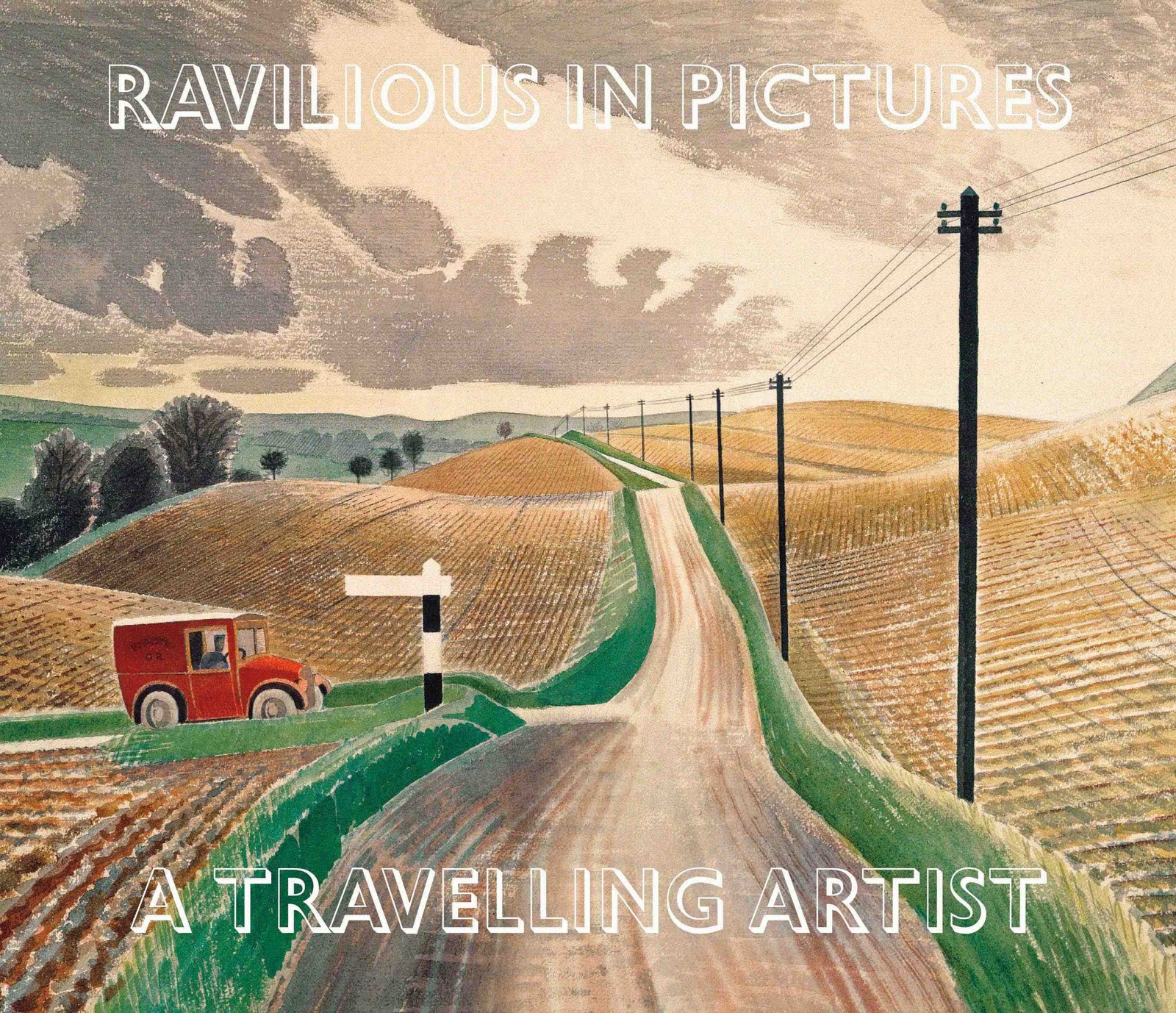
Showing posts with label 'Ravilious in Pictures: A Travelling Artist'. Show all posts

Sunday, 5 November 2023

ERIC RAVILIOUS: NEW YEAR SNOW

Eric Ravilious, New Year Snow, 1938, watercolour 


I wrote the note below for Dreweatts, who were selling New Year Snow in their recent auction, Robert Kime: The Personal Collection...

This atmospheric watercolour depicts a picturesque valley in the Welsh borders and, at the same time, shows us a master at work.

Early in 1938 Ravilious travelled to Capel-y-Ffin, a hamlet in the Honddu valley not far from the ruins of Llanthony Priory. Having concentrated on illustration and design for a couple of years he was at last free to paint watercolours, and to take his time doing so. He had booked a room in the hamlet’s solitary farmhouse for two months, and looked forward to exploring a landscape that was wilder than his native Sussex.

Steeped as he was in the English watercolour tradition, Ravilious was well aware that JMW Turner, John Sell Cotman and other luminaries had painted the valley before him, although those earlier Romantic artists had tended to focus on the ruined abbey. A more recent visitor was artist-poet David Jones, who had stayed with Eric Gill and his entourage in Capel-y-Ffin in the 1920s. Ravilious admired the strong modern line and delicate palette of Jones’s watercolours, which present subjects similar to this but in a very different style.

In New Year Snow Ravilious presented a recognisable view south-east along the valley, towards the distinctive buttress of Loxidge Tump. He was no topographer, however, and here he redirected the course of the river so that it bends across the composition, roughly mirroring the curve of hills against the sky. Water, land and sky are painted with remarkable economy, with only the lightest of washes across the hilltops. Mostly the watercolour has been applied in single strokes, often with a dry brush. The white paper showing through suggests here rough grass dusted with snow and there the shimmer of moving water, while conveying at the same time a feeling of light-heartedness and freedom.

In place of the ruins beloved of Turner’s generation, we have the kind of man-made object that delighted Ravilious: a sheep feeder on wheels set centre stage and at a precarious angle. This positioning and the clarity of the draughtsmanship lend a slightly dreamlike quality to the scene.

In May 1939 Ravilious held his third exhibition of watercolours at the prestigious London gallery of Arthur Tooth and Son, the show that cemented his reputation. In The Observer, Jan Gordon praised Ravilious’s extraordinary technique, which made the most mundane object ‘appear as something magic, almost mystic, distilled out of the ordinary everyday.’ Twenty-seven watercolours are listed in the catalogue; New Year Snow is No. 1.

I can't remember the exact figure, but the work ended up selling for over £300,000... New Year Snow is featured in my book Ravilious in Pictures: A Travelling Artist, published by The Mainstone Press.

Tuesday, 15 November 2022

Ravilious Pilot Boat up for auction!

Eric Ravilious, Pilot Boat, 1939

Having spent some time in a private collection in the United States, Pilot Boat is back in the UK and up for auction at Sotheby's. I'm not sure I've ever seen this watercolour in person so I'm looking forward to visiting on Sunday, when I join Frances Christie and Simon Martin for a panel discussion about Place in Modern British Art (see previous post for details).

A few years ago I wrote the following to accompany the illustration of Pilot Boat in Ravilious in Pictures: A Travelling Artist. As usual Tim Mainstone and I spent a long time pondering which works to include in the book - a process you certainly wouldn't describe as painful - eventually picking this one as an atmospheric depiction of a French Channel port on the eve of war. In many instances we can revisit the sites of Ravilious watercolours and find them unchanged, but not in this case...

If Ravilious painted an interior scene on a painting trip you can be sure that the weather made working outdoors impossible. Le Havre was so cold he could only work outside for short periods, so it was as well that he had picked a hotel in such a good location, just 100 yards from the Quai George V. He was first captivated by the sleek lines and yellow masts of a steam yacht belonging to the Rothschild family - ‘the most elegant boat I ever saw’ - but, as he reported, ‘there are splendid boats wherever you go, and striped and red buoys and a special green water, a grassy green’. 

Ordinary people were fascinated to see an artist at work but, with the French newspapers dominated by discussion of the imminent conflict, Ravilious was treated with suspicion by officials who perhaps took him for a spy. ‘A gendarme questioned me closely,’ he reported on one occasion, ‘but retired beaten by my Pigeon French.’ Within a year Ravilious would be questioned far more aggressively by armed British servicemen as he drew port scenes in his capacity of war artist.

For the people of Le Havre the anticipated Nazi invasion was swift. On June 13 1940, as thousands of Allied troops evacuated by sea, German forces entered the city, where they remained in occupation for the next four years. During this time the garrison turned France’s second largest port into a massive fortress, and this spelled disaster for the city when Allied forces landed in Normandy in June 1944. Beginning on 5th September RAF bombers and naval guns blasted the city, reducing the centre to rubble and filling the waterways with wrecks. The port Edward Wadsworth had known for 30 years, and which he described in correspondence with Ravilious as ‘a real gold mine of matter’, was destroyed.

The return of peace brought to Le Havre the renowned architect and town planner Auguste Perret, who set about building a new city over the ruins of the old, using modern materials with panache in a 20-year project of unparalleled ambition. Indeed, it has been recognised as such by UNESCO, which in 2005 designated the rebuilt port a World Heritage Site. As a reminder of the old port we have this painting, almost a winter version of Seurat’s luminous harbour scenes, with a similar spaciousness and even the same mooring posts. In the low sunlight the clean lines of the pilot boat stand out against a background that seems almost on the point of melting away, with ghostly figures dimly perceptible on the far side of the water the only sign of life. 

A fine marine study, the painting is also filled with foreboding; ‘I shall be surprised,’ he wrote on returning home, ‘If there isn’t a war by the middle of May and drawing and all other sensible things fade into the background, though Tooth’s assure me their business will carry on as usual.’

This is an extract from Ravilious in Pictures: A Travelling Artist (Mainstone Press). 

Pilot Boat is Lot 12 in Sotheby's auction of Modern British & Irish Art, which will be held on 23 November. You can view the lots between 18-23 Nov. 

I'll be talking about Place in Modern British Art with Frances Christie and Simon Martin at 1pm on Sunday 20 Nov.

Friday, 26 October 2012

Ravilious Lifeboat Print: Help for Heroes

Eric Ravilious, Lifeboat, 1938 (DACS/artist's estate)
The Towner Gallery has recently acquired 'Lifeboat', a 1938 watercolour by Eric Ravilious, on long-term loan. This gorgeous painting, which featured in 'Eric Ravilious: Going Modern, Being British' at RWA Bristol earlier this year, is unusually colourful for an artist who tended to prefer more muted tones.

The Mainstone Press, publisher of the 'Ravilious in Pictures' series, has just published a limited edition giclee print of 'Lifeboat', which for a short time is available exclusively from Towner. A percentage from all sales of the print will go to Help for Heroes, the charity chosen by the painting's owner. This seems fitting, given that Ravilious died on active service as a war artist.

'Lifeboat' is also reproduced in 'Ravilious in Pictures: A Travelling Artist', which I will be discussing next month, along with the other books in the series, at several illustrated talks (see panel on right). The V&A Study Day has sold out, but you can still buy tickets for the other events - if there's something you'd like to know about Ravilious or his work, come along and ask!


Friday, 23 March 2012

New Ravilious Event: Greenside Mural Fundraiser

I'm looking forward to giving an illustrated talk on Eric Ravilious to the Friends of the RWA tomorrow. It's sold out, but if you don't have a ticket I'm doing a second date on April 25th. Meanwhile, in another part of the country...

And this is what it's all about:

Monday, 5 March 2012

'Ravilious in Pictures: A Travelling Artist' - Excerpt

Eric Ravilious, Belle Tout Lighthouse, 1939, private collection (DACS/artist's estate)
 
Belle Tout Lighthouse, 1939

We may notice the view first, those green grassy clifftops and the sea sparkling below, but almost immediately our attention is drawn back to the window itself, with its bold white bars alternately lit or cast into shadow by the bright sunlight. Above it the ceiling seems to be curved like a dome and beautifully decorated: a most unusual ceiling for a most unusual room. Having painted several watercolours of lighthouses, Ravilious had now found one he could sketch from the inside.

As a boy growing up in nearby Eastbourne, Ravilious no doubt visited Beachy Head and its lighthouses, Belle Tout perched on top of the cliffs and its replacement in the sea below; you can see it in the upper left of the painting. When he was born the newer lighthouse had only been operating for a year and its construction, in perilous conditions and in full public view, was the stuff of legend. Belle Tout, meanwhile, became a private house and was eventually bought, in 1923, by Sir James Purves-Stewart, an eminent neurologist.

Sir James was not averse to visitors, and once played host to George V. The king, he wrote in his autobiography The Sands of Time, ‘took a keen sailor's interest in the various gadgets that had been fitted up. When we came to the foot of the spiral staircase leading to the lantern room, Queen Mary was already aloft, enjoying the stunning view. She called down to him, “George, don't come up here, it's far too steep for you.” To which his majesty replied, “Dammit, I'm coming.”’

One can imagine the eminent doctor - or his wife, perhaps - noticing Ravilious sitting with his sketchbook on the clifftop and inviting him in. The artist had spent many hours already on the cliffs in the howling wind, producing the splendid night scene included in Sussex and the Downs, and was delighted to find himself inside the lantern, ‘in the greatest comfort with my jacket off’.

Not that living in a lighthouse was without its dangers. Sir James had been warned early on that erosion of the soft chalk cliffs would one day imperil his new home, but a respected geologist opined that the building would be safe for six centuries. This proved optimistic, and by the mid-1990s a series of major rock falls had brought Belle Tout almost to the edge of the precipice. Rather than despair, however, owners Mark and Louise Roberts sought expert advice and learned that the lighthouse could be raised by hydraulic jacks, lowered onto skates and thus moved to safety. Preparations began, only to be halted by the discovery of two unexploded bombs on the beach, but in March 1999 the extraordinary move began. Today you can see the view from the lantern yourself; following a change of ownership Belle Tout Lighthouse opened as a hotel in March 2010, and the former lantern has become a sitting room – with a view.

This is an excerpt from 'Ravilious in Pictures: A Travelling Artist', which is available now from The Mainstone Press.

The book will be launched officially on Saturday 10th March, 12-2pm, at The Royal West of England Academy, Bristol

Friday, 2 March 2012

Eric Ravilious & Tirzah Garwood: One Couple, Two Exhibitions

Tirzah and Eric Ravilious painting a mural at the Midland Hotel, Morecambe
Artist couples are fascinating. Like the rest of us they have a public life and a private life, only the hidden world of an artist couple or family is often revealed - if only in tantalising glimpses - in correspondence, diaries and in artworks themselves. In some cases the relationship has proved inspirational to both halves of the couple, but often one artist's work tends to pushed into the background as the career of the other takes off.

Still going strong in 2012
The history of 20th century British art is rich in artist couples. There are those who, like Gilbert and George, have pooled their identities to form an artistic double act and others, among them Mary Fedden and Julian Trevelyan, who succeeded in maintaining parallel careers. This was true too of Ben and Winifred Nicholson, a couple whose artistic relationship long outlived their marriage; they were still busily writing to each other about painting decades after splitting up, although you wouldn't know it to judge from the books about Ben.

I was at the Central Library in Bristol the other day - it has a wonderful art history collection - and on asking about Ben Nicholson in the Reference section was presented with a trolleyful of books, each one progressively bigger and glossier and less comprehensible. His first wife merited a solitary book. 

Personally, I think Winifred's best work is beautiful. I also think the importance of intimate relationships is underplayed in conventional art history, which tends to consider artists in terms of similar artists and via the art historical theories of the day. An artist is only 'important' if they fit within the narrative - but you don't need me to tell you that...

Winifred Nicholson, Bonnie Scotland, 1951 (Tullie House)

Eric Ravilious was virtually invisible ten years ago and is now a central figure in the alternative story of 20th century British art that Alexandra Harris has championed in her 2010 book 'Romantic Moderns'. The exhibition of his watercolours which opens at the RWA in Bristol next week will be the third show in consecutive years, each one given little attention in the national press but attracting unprecedented numbers of visitors nonetheless.

Tirzah Garwood, The Train Journey, 1929-30

His work also features in a second exhibition opening this month, at the Fry Art Gallery in Saffron Walden, but he is not the main subject. 'Long Live Great Bardfield!' is a show about Rav's wife, Tirzah, and the creative force behind it is Anne Ullmann, their daughter and the author/editor of several stunning books about them. Over the past few years she's been editing her mother's autobiography, 'Long Live Great Bardfield, & Love to You All', which is about to be published by the Fleece Press.

Eric Ravilious, Train Landscape, 1939 (Aberdeen Art Gallery)
I've written before about Tirzah, who learned wood engraving from Eric and as Tirzah Garwood became an outstanding printmaker in her own right. She gave this career up to concentrate on raising her children, but didn't give up art per se. Throughout her married life she made marbled papers, which at different times she sold through London boutiques, and she also assisted Eric, publicly when he was commissioned to paint murals at the Midland Hotel, Morecambe, and privately in ways we will probably never fully appreciate. Her contribution to the painting 'Train Landscape' (1939) is one of my favourite instances.

Tirzah Garwood, Orchid Hunters in Brazil, 1950 - there's a story to this...
After Eric's death she took up oil painting and also made a series of unusual relief pictures of shops. This work is rarely shown, except at the Fry, and the appearance of two examples on the Antiques Road Show last year caused some consternation to their resident expert. Now we have the opportunity to look at Tirzah's work properly and also to read what she thought about married life with Eric. Famous for her fiery letters, I suspect that she had a thing or two to say...

'Eric Ravilious: Going Modern / Being British' is at the Royal West of England Academy, Bristol, from Saturday March 10th.

'Long Live Great Bardfield!' opens at the Fry Art Gallery, Saffron Walden, on March 31st.

Wood engravings by Eric Ravilious are included in an exhibition of work from the archive of the Society of Wood Engravers, showing until March 23rd at Manchester Metropolitan University.

'Ravilious in Pictures: A Travelling Artist' will be launched at the RWA on March 10th, 12-2pm

Friday, 24 February 2012

John Piper, David Jones & The Queen: Art in Cardiff

John Piper, Llanthony Priory, 1941 (private collection)
By the time I'd worked my way through both rooms of the The Queen: Art and Image at the National Museum of Wales, one thing was clear: this is a monarch who likes having her picture taken. There are photos of her smiling, photos of her tight-lipped, magisterial pictures in which she looms over the viewer. I don't spend a lot of time worrying about the monarchy, but one or two of the photos oozed power. Never mind all that democratic nonsense, I found myself thinking, she's the boss. By contrast, Lucian Freud's tiny painting makes her look like a camp little man of a certain age. I guess he was trying to tell us something too.

But I wasn't in Cardiff to look at Royal portraits. In fact I didn't know the exhibition was on until I walked into the room and saw the same face repeated over and over, reimagined by Warhol, Gilbert and George and sundry others but still essentially the same unknowable woman. If there is a real, hidden Elizabeth beneath the public persona, this exhibition leaves her in peace.

Pietro Annigoni, Queen Elizabeth II, 1969 (Nat Port Gall)
I'd been meaning to visit the Welsh equivalent of the National Gallery for a while, to see a temporary exhibition of work by David Jones, and when I read that a Piper exhibition had just started as well I rushed down to Temple Meads and took a train Across the Border. It's been a while since I visited Cardiff, and I was struck on arrival by how different it is: flat, expansive and conceived on a grand scale. The place has the air of a provincial French city, a character best expressed in the flamboyant old stone palaces that house the City Hall and National Museum, and in the neighbouring parks and boulevards.

Once inside the museum I headed straight for the Piper show, a public display of a private collection comprised mostly of dramatic mountain scenes. I hadn't realised before quite how much time that quintessential wandering artist spent in Wales, but it seems he practically lived in Snowdonia in the 1940s and 1950s. Personally, I don't think that the mountain paintings, which are dramatic but rather formless, show him at his best, but there was one gorgeous treat: a painting of Llanthony Priory from the 1940s. Nobody has ever captured the peculiar atmosphere surrounding an English or Welsh church quite like Piper, and here the dramatic contrast of darkness and light (the wall on the right is a dazzling golden yellow) is enhanced by a wonderful texture; the paint surface is covered in swirls and squiggles that almost form a pattern but instead reinforce the sense of age and beauty.

Thank heavens he gave up abstraction.

David Jones, Capel-y-ffin, 1926/7 (NM Wales)
I got distracted by the Queen after that, but presently located the corridor where a dozen or so paintings by David Jones hang in light so carefully controlled that you peer at the pictures as if through a Welsh mist. Which I suppose is authentic. Jones is less well-known than Ravilious, Bawden and other watercolourists of the age, partly because his subject matter and style are eccentric, to say the least, and partly because he chose to work so lightly that he makes Rav, by contrast, seem as bold as Matisse.

A Londoner of mixed Anglo-Welsh parentage, Jones served in the Great War and subsequently suffered two nervous breakdowns that hampered his career just as he was becoming established. This was in the early 1930s, after a productive decade which he had spent working alongside Eric Gill, first at Ditchling, Sussex, and then at Capel-y-Ffin in the Welsh Marches. In later years Jones produced increasingly odd pictures, often in pencil and crayon, covering the paper with mythical figures, plants and flowers and symbols of one kind and another. These are fascinating but less accessible than his landscapes from the 1920s which, though sometimes agonisingly delicate, are beautifully crafted and highly original.

Gwen John, Girl in a Green Dress (NM Wales)
I was hoping to see some of his work from Capel-y-Ffin, and was rewarded with one lovely picture. The man was evidently brilliant (TS Eliot described his epic 1937 war poem 'In Parenthesis' as a work of genius) but with little interest in artistic fame. I want to see more!

Another artist of that productive era of whom the same could be said is Gwen John (who was born in Pembrokeshire), and it was a pleasant surprise to happen upon a clutch of her portraits hanging next to a group of her brother's. Where Augustus John's pictures are bright and expressive - crying out to be noticed, you might say - Gwen's are self-effacing and thoughtful. In a couple of the portraits the subjects seem about to fade into the background, but they are beautiful nevertheless.

James Dickson Innes, Arenig, 1913 (NM Wales)
The art galleries of the National Museum are full of treats like this. I'd been wanting for a long time to see some paintings by James Dickson Innes, a bohemian friend of Augustus John who died of TB in his twenties, and here were half a dozen or more, scattered through the collection. I could see right away why people used to rave (maybe they still do) about the jewel-like colours in his landscapes, which are mostly small but striking.

One final surprise awaited me in the room devoted to Welsh landscape: a picture I've been thinking about a lot over the past year. 'Waterwheel' is one of my favourite Ravilious paintings, and one that features in 'Ravilious in Pictures: A Travelling Artist', and it was fascinating to come across it like that, unexpectedly and in a room full of landscapes by other artists of different generations. What struck me instantly was the quality of the light, both the luminous sky and the radiance surrounding the waterwheel like a halo. In that brightness I felt the motion of the waterwheel and heard the gurgling water - a place (Capel-y-Ffin) and a moment (dawn, early March 1938) brought to life.

Eric Ravilious, Waterwheel, 1938 (Brecknock Museum)

'Ravilious in Pictures: A Travelling Artist' is being bound, and will be available very soon! Come and say hello at the RWA, Bristol on Saturday March 10th, when I'll be signing copies...

Sunday, 12 February 2012

Eric Ravilious: Illustrated Talks for 2012

Eric Ravilious, Rye Harbour, 1938
I've just proof-read 'Ravilious in Pictures: A Travelling Artist' for the last time, so now it's up to the printers, who I'm sure will produce a fabulous book. It's strange to think that almost four years have passed since we first started talking about 'Sussex and the Downs', which in turn grew out of the quest Tim Mainstone and I went on to find the shops depicted by Ravilious in 'High Street' (1938).

One of the things I've really enjoyed about this whole adventure is meeting people at talks, signings and exhibition launches, so I'm excited to have lots of events coming up. Mostly these are illustrated talks in which I show slides of paintings, archive photographs and my own pictures, and talk about the stories and characters associated with them. So far, the dates booked for this year go like this:

Saturday March 10th, 12-2pm: Launch and signing of 'Ravilious in Pictures: A Travelling Artist',
Royal West of England Academy, Bristol.

Saturday March 24th, time TBC: Illustrated Talk on Eric Ravilious, RWA, Bristol (contact RWA for ticket info).

Tuesday March 27th, 7pm: Celebrating Eric Ravilious, Illustrated Talk at The Old Chapel Centre, Alfriston, Sussex (contact Much Ado Books for ticket info).

Thursday June 28th, time TBC: Eric Ravilious & the White Horses of Wiltshire, Illustrated Talk at the Assembly Room, Town Hall, Devizes, Wilts (part of Devizes Festival - see website nearer the time for ticket info)

Sunday Sept 2, 3pm: Eric Ravilious: A Life in Pictures, Illustrated Talk with me AND Alan Powers at the Birley Centre, Eastbourne (ticket info nearer the time from Friends of the Towner)

Friday Sept 21st, time TBC: Two Travelling Artists - Paul Nash & Eric Ravilious, Illustrated Talk at the Rye Arts Festival (info from Rye Arts Festival nearer the time)

I don't think I've missed anything out, although it's always possible... Other events will probably be arranged as the year progresses. If you're interested in booking a talk, please get in touch via the Comments or Twitter, or contact The Mainstone Press.

Monday, 30 January 2012

Ravilious Watercolours on Show in March!

We'll be launching the new book at the RWA, Bristol, on Saturday 10 March!
Exciting news for art lovers in the West Country! On 10 March an exhibition of watercolours, wood engravings and lithographs by Eric Ravilious (1903-42) will open at the Royal West of England Academy here in Bristol.

After the phenomenal success of Ravilious shows in Eastbourne (Towner, 2010) and Saffron Walden (Fry Art Gallery, 2011), it will be wonderful to see a substantial body of work on display in the West of England. I haven't seen a full list of pictures yet, but there will definitely be some favourites on show, alongside paintings that people may not have seen before.

from Ladies Who Travel
At the Towner exhibition, 'Familiar Visions', we saw the artist's paintings of Sussex alongside his son James Ravilious's photographs of Devon. The Fry also took a regional angle, concentrating on 'Ravilious in Essex'. This time around the organisers are taking a slightly more academic approach, using the title 'Going Modern/Being British' as a starting point. It was Paul Nash, the painter's teacher, who asked in the early 1930s whether it was possible to be a modern artist while retaining qualities he considered to be traditionally British. In paintings like 'Event on the Downs' he tackled this question head on, but he'd already addressed it in more subtle ways earlier in his life.

He was particularly influential in the 1920s as a champion of wood engraving and watercolour. These were in no sense new media, but they had been so neglected in the 19th century that they must have seemed fresh and exciting to young artists in the aftermath of the Great War. Nash's 1924 exhibition of landscapes in watercolour was a dazzling success, but with most of the pictures in private hands it is difficult for us to appreciate just how good - and how innovative - this work was.

We are much luckier with Ravilious, who was studying with Nash at the time and went on to master both of his teacher's favourite media. As a wood engraver he was rarely surpassed - a fact that was acknowledged during his lifetime - but as a watercolourist the very good reputation he had built up before his death is only now recovering from a long period of neglect. It's wonderful that so many of his paintings have survived, in excellent condition, and that so many are either in public collections or owned by people who are more than willing to lend them for exhibitions.

Eric Ravilious, Interior at Furlongs, 1939 (DACS)
Ravilious is often described as 'quintessentially English' rather than British, a distinction which I think makes him seem a slightly parochial figure - as does his lack of interest in artistic movements and theories. In fact he numbered Henry Moore and other modernist luminaries among his friends, and travelled as widely as circumstances allowed; he painted ordinary things - an old car, a greenhouse, a barbed wire fence - in a way that made people see them in a new light, which suggests a modern mind at work.

David Hockney, Winter Timber
I'm glad this show will be on at the same time as David Hockney's exhibition at the Royal Academy. The two exhibitions will prove a wonderful study in contrast, with giant, boldly coloured pictures on the one hand, and small, delicately-nuanced paintings on the other - brass band vs solo violin. Yet the two artists also have so much in common, in particular a vital understanding that mystery and beauty reside in the most ordinary scenes.

Eric Ravilious: Going Modern/Being British is at the RWA, Bristol, from 10 March until 29 April
David Hockney: A Bigger Picture is at the RA, London, until 9 April

We will be launching 'Ravilious in Pictures: A Travelling Artist' at the RWA, Bristol, on 10 March, and on 24 March I will be giving an illustrated talk based on my researches for the new book, also at the RWA.

Friday, 20 January 2012

Dungeness

Miniature railway, lighthouses, shingle - Dungeness!
In the autumn I enjoyed a whistlestop tour around Rye and environs, a part of the world I knew well from the work of artists I love but hadn't visited in years. The place I had heard most about was undoubtedly Dungeness, that great parson's nose of shingle jutting out from the flat Kent coast a few miles south of the hilltop town.

Actually I read about it first, in Derek Jarman's wonderful, elegiac book 'Modern Nature'. This must have been twenty years ago, but both the tone of the book and the descriptions of the film-maker's strange, stony garden stayed with me. A dying man attempting to tease life out of salt-encrusted shingle, in the shadow of a nuclear power station? I didn't like his films, particularly, but this was a wonderful tale.

Prospect Cottage, Derek Jarman's former home (private - please respect)
Other stories about Dungeness reached me over the subsequent years. I remember the sound of feet scrunching over shingle in a Radio 4 documentary, a programme which left with me an image of stones lying in great undulating waves, so that when you stood in the midst of them you could see nothing else.

Then I came across the painting by Eric Ravilious that features in 'Ravilious in Pictures: A Travelling Artist', which gives a completely different impression. His version is more like a scene from an old-fashioned Sci-fi movie, with improbable modern structures dotted around a desolate shore. Dungeness had been popular with artists since at least the mid-19th century, when dramatic scenes of ships in peril were so much in vogue. More recently, that intrepid travelling artist John Piper had made several lovely pictures of the lighthouse and attendant buildings, using his favoured media of pen and ink, gouache and collage. Ravilious may have seen these, which would partially explain his idiosyncratic choice of subject and angle.

Eric Ravilious, Dungeness, 1939, private collection/DACS
Anyway, one bright morning in September I set off from Rye. As I drove south the weather changed, the clouds not so much moving in as forming around me, and by the time I reached the deserted holiday camps and hotels of Camber Sands it was drizzling. The country beyond reminded me of Lincolnshire or the Baltic coast, but that was probably just the weather. To the right the land was fenced off, miles of it, and looking at the map afterwards I realised it was an army range. I drove through Lydd, read a report in a local paper that trumpeted the expansion of the local airport as the only hope for the local economy and lambasted the bird lovers of Dungeness for their opposition to the plans, and carried on.

Approaching my destination on a narrow lane it was clear that this was one of the world's stranger and more wonderful places. To the right the industrial bulk of not one, but two nuclear power stations. To the left, an evenly-spaced row of houses, each slightly different to its neighbour, which stretched away along the coast towards Dymchurch, as far as I could see. And all around, the most extraordinary landscape - a kind of miniature Lake District with hills ten feet high and no plant taller than a gorse bush.


As I got closer to the coast the vegetation grew sparser, the shingle more obvious, until I was driving along an even more makeshift road with the odd wooden chalet on one side and on the other a wave of stones that formed a crest above the shoreline. On this crest, outlined against the grey sky, brightly painted boats were perched ready for launching, while closer at hand lay the skeletons of older, abandoned boats with bleached and broken timbers. Among these were other relics - huts and bits of winding machinery, and long, snaking sections of narrow gauge railway track. Up ahead were the lighthouses and on my right, as I went slowly along, Prospect Cottage with its matt black walls and bright yellow trim, and the bizarre ornamental garden created by Derek Jarman in the last years of his life.

The Low Light, built C19, converted to foghorn station C20
Few places I've visited have such a powerful and unique identity as Dungeness and I could see instantly why Ravilious had felt at home. The lighthouses and miniature railway and power stations and eccentric little houses were part of it, but what appealed to me most was the evidence of passing time.

While the cliffs of Beachy Head, just along the coast, are constantly being worn away, the shingle bank is continually growing, and as the sea retreats so the fishermen and other inhabitants of this peculiar settlement follow it, leaving behind on the stones whatever they no longer need. Everywhere was evidence of past endeavours, although I found no trace of the lighthouse on which Ravilious focused his attention, the so-called Low Light installed in the 19th century to supplement the main lighthouse.

Prospect Cottage
What a place to create a garden in the face of death. What a place for a painter of everyday marvels. I can't wait to go back.

'Ravilious in Pictures: A Travelling Artist' is published by The Mainstone Press at the end of February.

Thursday, 29 December 2011

'Great Expectations' & 'Ravilious in Pictures: A Travelling Artist'

The Greatest 'Great Expectations'? David Lean's 1946 film
Watching 'Great Expectations' the other night I was reminded how important a sense of place can be. Pip and Magwitch are both creatures of the marsh, the lowest of the low. No wonder Pip's sister goes on in typically Dickensian fashion about being 'raised up' - out of the swamp and into society.

It's easy to take the places chosen by artists, writers and film makers for granted. We think of them as settings - a backdrop to the action - yet a place is often integral to the story. Charles Dickens understood perfectly that a place - whether a marshy seashore or a tenement building - can hold tremendous power. Victorian London was a thriving modern city, yet we remember the corners Dickens made into fiction, drawing out the emotion attached to old, picturesque or terrifying streets. Much of his London was composed of relics of the previous century, the city that was rapidly disappearing as the one we know grew up.

David Hockney, Looking at Woldgate Woods, 2006
Some writers and artists focus on places they know intimately. Thomas Hardy reimagined his native Dorset, Stanley Spencer the country around Cookham. Can we envisage the work of either separate from the location? And what about the Brontes? Or John Constable? Having abandoned dowdy Britain for the bright colours of California, David Hockney has returned home, West Coast palette in hand, and found new inspiration in familiar scenes.

Dickens was rather different. He went in search of places and scenes that came with emotional resonance or topicality built in, and in books like 'Hard Times' he borrowed heavily from the dramatic newspaper reports of the day. It's interesting to compare his lifelong quest for captivating places to that of JMW Turner, an artist who travelled widely to find subject matter that captured the violent changes wrought by the steam age.

JMW Turner, Snow Storm - Steam-boat off a Harbour Mouth, 1842, Tate
Curiously, the painters who followed him didn't seem so keen on the subject of place; think of the Pre-Raphaelites with their studied figures. While the work begun by Constable and Turner was taken on by painters across the Channel, it took a new century and the upheaval of the Great War to drive British artists out of their studios on a mass exploration of coast and landscape. After the mechanized brutality of the Western Front there was an understandable desire to 'get back to nature', and at the same time the production of cars and buses by factories that had previously made armaments enabled people to visit ancient sites, historic villages and beauty spots.

Paul Nash, Sudden Storm, 1918 (print from watercolour)
Painters turned their attention to places with an enthusiasm not seen since the early 19th century. Paul Nash set the tone, putting watercolour to use as a medium of modernity and teaching his students at the Royal College of Art to do the same. Among these were Edward Bawden and Eric Ravilious, both of whom took to the medium of John Sell Cotman and Francis Towne with great success - Ravilious never got on with oil paint, which he likened to toothpaste.

In his watercolours, Ravilious focused almost exclusively on place, with figures appearing sometimes as part of the scene, and his career progressed he went further and further in search of inspiration. This quest for new subject matter took him around Britain and into northern France, and it forms the basis of 'Ravilious in Pictures: A Travelling Artist', the fourth volume in the series published by the Mainstone Press. There are some glorious paintings in the book, from pictures of Rye Harbour and Newhaven to watercolours of Capel-y-Ffin and the Welsh hills, and some wonderful stories.

Eric Ravilious, Rye Harbour, 1938 - note Dickensian mudbank
An enthusiastic and accomplished letter writer, Ravilious left brilliant and often hilarious descriptions of the places he visited and people he met, without revealing exactly what he was looking for when he went out to paint, or analysing his work. This fourth book has been particularly fun to research and write, and as it goes into production I'll post the odd excerpt and some more descriptions of my own travels, following this genial ghost around the countryside...

'Ravilious in Pictures: A Travelling Artist' will be published by the Mainstone Press in late Feb 2012.