Showing posts with label Towner. Show all posts

Friday, 14 May 2021

John Nash: The Landscape of Love and Solace


John Nash, The Cornfield, 1918 (Tate)

Few paintings express a soldier’s joy in returning safely home as beautifully as The Cornfield, John Nash’s gilded vision of corn stooks dancing a jig (or so it seems) on a Buckinghamshire hillside. In the summer of 1918 the war was still raging, but he had been plucked from his foxhole in the Flanders mud to work as a war artist alongside his brother Paul. Their days were spent in a former herb-drying shed, working for the Ministry of War on paintings that would serve as a memorial to the conflict. While Paul recreated the phantasmagoric landscapes he had witnessed as an observer in the autumn of 1917, John worked from his firsthand experience of battle to produce first Over The Top, a painting that simply and hauntingly portrays the human cost of war, then Oppy Wood, in which the ghastly trench landscape is shown beneath a sky of blue. The battle was dreadful, the painting seems to say, but it is over.

Think of John Nash and it is probably one of these three oil paintings that will spring to mind. The long and productive career that followed Nash’s brief sojourn as a war artist has largely been forgotten. Indeed, Andrew Lambirth’s elegant 2019 monograph is the first major book on the artist ever published, and The Landscape of Love and Solace, accompanying the new book of the same title by Andy Friend, is the first large-scale exhibition since Nash’s 1967 retrospective at the Royal Academy. Without a strident champion many artists fade from public view after death, and only the best have a chance of being resurrected years later. In Nash’s case such a revival has been on the cards for a while, but the timing of this joyful, sensitive exhibition could not be better. After a year of gallery deprivation visitors to Towner are in for a treat.

Although he lacked formal art school training Nash was from an early age both a gifted draughtsman and acute observer of nature. His love of plants evolved into a passion for gardening, and with a large swathe of the British public sharing this enthusiasm, magazine and book publishers commissioned him to make exquisite botanical illustrations in a variety of media. His line drawings are sensational but Nash was also, lest we forget, one of the pioneers of modern wood engraving. His wicked, wonderful 1927 book Poisonous Plants is a treasure that reveals both his skill as an engraver and the complex chiaroscuro of his personality. Nash experienced more than his share of heartbreak and suffered lifelong from periods of depression. But he retained a delicious sense of humour and a passion for the countryside, the latter inspiring the oil paintings and watercolours of hills and farms, woods and ponds that are his true legacy. There is no overt symbolism or overpowering design in paintings like The Lake, Little Horkesley Hall. The composition is subtle, the tones carefully balanced and the brushwork delicate. These paintings need to be savoured. Like the hidden places Nash sought out, they reveal their secrets slowly. 

John Nash: The Landscape of Love and Solace is at Towner, Eastbourne. I wrote this preview for the May 2021 issue of World of Interiors. 

Monday, 21 July 2014

A Modern British Summer!

Paul & John Nash reunited at RWA Bristol
For a long time the auction houses and dealers have been enjoying a boom in Mod Brit, as 20th century British art is known in the trade. Or rather, as 20th century British painting, sculpture and artist-made design is known.

For those baffled by artspeak, there's a world of difference between 'modern', which now refers to a period from about 1910 to the beginning of the Saatchi era, and 'contemporary', which refers to art being made now - or some of it, at least. For art to be 'contemporary' it generally needs to be non-traditional, as 'modern' art used to be. Nowadays Edward Seago is 'modern', and you don't get much more traditional than him.

JD Fergusson, Bathers: Noon, 1937, (c) The Fergusson Gallery
Of course some Mod Brit artists really were modern. Take JD Fergusson, the Scottish painter who immersed himself in the vibrant visual culture of early 20th century Paris and brought home a wild palette and a boundless zest for life. One of the world's great colourists, he has remained popular since his death in 1963 - but neglected south of the border. Now, however, Pallant House is offering English fans an opportunity to revisit Fergusson's work, as curator Simon Martin explained to me recently.

'Over the past few years,' he told me, 'Pallant House Gallery has carved a niche in presenting reappraisals of overlooked British artists and themes.

'The JD Fergusson exhibition has come to us from the Scottish National Galleries and is very timely as it the first solo museum show of this Scottish Colourist in England for over forty years, and demonstrates the important point that British artists were not working in a vacuum, but working in continental Europe as part of the international avant-garde.'

Great exhibition, great catalogue...
Simon made a name for himself a few years ago with a brilliant exhibition devoted to another overlooked British artist, Edward Burra - a painter of extraordinary originality and verve - and since then Pallant House has become one of several out-of-London museums catering to the renewed interest in all things Modern and British.

Dulwich is only just out of London, but the need for visitors to leave the West End and venture onto the rail network does make Dulwich Picture Gallery a not-quite-London venue. Famous for its gorgeous permanent collection, DPG has also embraced Mod Brit following the startling success in 2010 of 'Paul Nash: The Elements', David Fraser Jenkins' memorable exhibition.


Until 21 September you can enjoy 'Art and Life', a delightful exhibition devoted to the work of Ben and Winifred Nicholson, Christopher Wood and others, in an environment ideally suited to the pictures. These artists, like many of their generation, painted on a relatively modest scale, and the work feels at home in the intimate exhibition gallery at Dulwich. I enjoyed seeing the exhibition at Kettle's Yard, but the paintings come to life in a different way in their current home - worth taking the ten-minute train ride from Victoria to see them again!

Closer to home (for me, at any rate), and close to my heart, is the new RWA exhibition devoted to the careers of Paul and John Nash. I have spent a lot of time over the past few years writing about, thinking about, and generally going on about Paul Nash, and I wish there weren't so many books about him so I could write another one. Oh well.

Paul Nash, Dymchurch, c1922-4, Dudley Museums Service, (c) Tate
A few years ago I had the idea of celebrating the centenary of the Nash brothers' first (and only) joint exhibition, which took place in 1913. I approached the RWA, with whom I had worked on an exhibition of Ravilious watercolours, and they decided to include 'Brothers in Art' as part of their impressive Great War centenary programme. I've been too busy elsewhere to get involved, but curator Gemma Brace has put together a mouth-watering selection of pictures by both artists, including one of the nation's favourite paintings, John's 'Cornfield'.

Like many smaller institutions the RWA is handicapped by the prohibitive charges levied by larger museums and estates for reproduction rights, making it very difficult for them to promote the exhibition nationally, but I hope that word spreads around the grapevine. There are pre-Great War paintings by both artists that have rarely, if ever, been shown publicly before, along with later pictures that are justly celebrated. From Paul a lovely oil of Dymchurch and 'Eclipse of the Sunflower', from John languid views of Bath and the eye-of-God vision of 'Gloucestershire Landscape'.

Almost my favourite picture on public display anywhere in Britain right now is Paul Nash's early watercolour of elm trees in the blue summer dusk, which is featured in the exhibition.

Meanwhile, in another part of the country... we have Towner's wonderful Peggy Angus show, which is full of surprises. When Sara Cooper and I were planning the exhibition we faced a particular challenge in the varied nature of Peggy's career. On the surface, at least, her paintings are very different from her tile designs, and what about her long and distinguished teaching career? How on earth do you represent years in the classroom in a museum show?

As it turned out, her fabulous wallpaper (hand-printed for us by her grand-daughter Emma Gibson) offered a way of pulling the disparate aspects of her career together - as well as causing a lot of jaws to drop. Besides, these different sides of her life were not actually so different. Look for instance at the curving line of the railway in one of her paintings of Asham Cement Works, and then at the undulating design in her Lansbury tile mural, and you can see the same hand behind them. Similarly, the design work she did in the classroom relates closely to her commercial work. Thanks in part to Towner's moveable walls, the exhibition flows nicely, showing us different sides of a single, inspiring, creative mind.
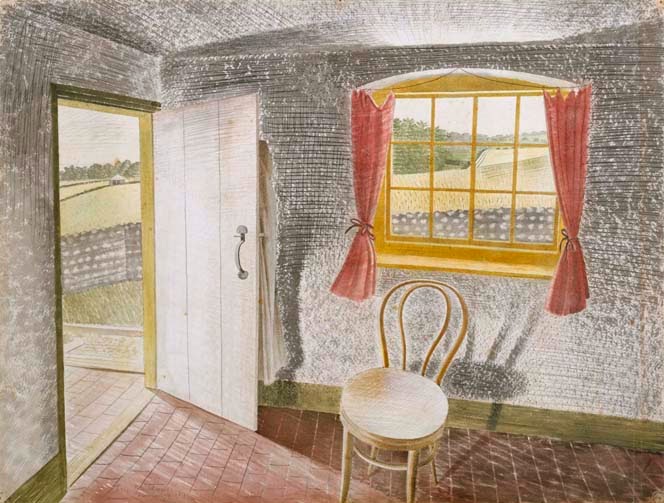
Eric Ravilious, Interior at Furlongs, 1939, Towner

Peggy Angus, The Three Bears, c1945, (c) Estate of Peggy Angus/DACS
We thought a great deal about whether to include Ravilious paintings in the exhibition and decided they were so immediately relevant - given the artists' friendship and shared artistic interests - that it would be crazy not to. Although Ravilious was the superior painter overall, I don't think Peggy's pictures of the cement works, or of Furlongs, suffer by comparison.

Rather, his 'Interior at Furlongs' and her paintings of the same subject complement one another, while the fantastic stage set of the famous table and chairs is a must-see for any true Ravilious devotee. There is even an oil lamp on show that he bought for Peggy from a Lewes junk shop.

In part I think the growing fascination with all things Mod and Brit has a lot to do with our distance from those days, especially the 1930s. You have to be of a fairly decent age now to remember the decade with any clarity, and for those born in wartime or afterwards it has the same air of mystery and nostalgia that the Victorian period had for their parents. For young artists and designers, meanwhile, Peggy Angus must come as something of a revelation - a talented maverick who enjoyed not one but several careers, leaving behind an extraordinary body of work.

FFI:
JD Fergusson at Pallant House
Art and Life at Dulwich Picture Gallery
Brothers in Art: Paul and John Nash at RWA Bristol
Peggy Angus: Designer, Teacher, Painter at Towner


Also playing:

From David Bomberg to Paula Rego: The London Group in Southampton at Southampton City Art Gallery - a century old this year, having been set up on the eve of the Great War to help artists who were shunned by the Establishment, the London Group is still going strong today. It describes itself as 'a thriving democratic co-operative of artists practicing in all disciplines, from painting and sculpture to moving image and performance, with a full annual events programme in London and beyond.'

Keith Vaughan at the Fry Art Gallery, Saffron Walden - an exhibition 'specially devised to reflect the influence of north west Essex on Vaughan by showing 'Essex work'. Vaughan enjoyed relaxing in the Essex countryside where he could explore the constant changes in the natural world and the open sky as a contrast to his life in London. He was also interested in the juxtaposition of geometric shapes provided by vernacular architecture. Many of his later paintings can be traced back to photographs that he took in Essex whilst living at Harrow Hill.'

Kenneth Clark - Looking for Civilisation at Tate Britain

Apologies if I've missed out something obvious - please add a comment!


Wednesday, 16 July 2014

Peggy Angus on Film


This film was shot just before the Private View of the Peggy Angus exhibition at Towner last week. You have to wait a while for David Dimbleby, but there are some great pictures of the show. Sara got to stand in front of the Sun and Moon wallpaper, which is most unfair.

The film was made by Bourne Iden TV.

Peggy was also featured in The Observer a couple of weeks ago; you can see the article by Rachel Cooke and accompanying slideshow on the Guardian website.

I'm back in Eastbourne on Saturday (19 July), giving an afternoon talk on Peggy's life and work... The weather forecast isn't very good for Saturday, so why not come and be entertained for an hour! Info here.


Friday, 4 July 2014

What links... Kenneth Clark, British Folk Art & Peggy Angus?

How's that for Folk Art? Lady Godiva Clock, Coventry, with tile mural by Peggy Angus
Hooray for Tate B. Not just one but TWO inspiring exhibitions on at the same time. I thought a show devoted to an art historian and cultural bigwig might be a bit dry, but far from it. Fascinating to see the work Kenneth Clark collected, all those delicate Cezanne drawings for example, and the pictures he was looking at during his formative years.

Here was a portrait of an art lover whose watchwords seemed to be refinement and modesty - a patron whose genteel good taste and position in the art establishment greatly assisted the careers of Henry Moore, John Piper, Graham Sutherland and other artists of equally rare sensibility.

A bit of a shock, then, to go from the world of 'Civilisation' to the multifarious oddities of British Folk Art, an exhibition which is probably more popular than its debonair rival but which must have been fairly nightmarish to curate. I mean where do you begin? What do you include? The curators seem to have taken a similar approach to Barbara Jones in her wonderful book 'The Unsophisticated Arts', in that they have gathered together work that shares certain characteristics but without trying to define it too closely or to include everything.

Buy the new edition from Little Toller!
Like the book, it's an eclectic, individual survey of figureheads and shop signs, textiles and amateur paintings - a display put together (it seems) by enthusiasts with a good eye for an object, rather than academics with a point to make. In the same way some of the artists championed by Kenneth Clark picked up on interesting or quirky objects or designs. Eric Ravilious loved weathervanes, shop emblems and junk of all kinds - you could put together a mini-folk art show from his prints and paintings. Edward Bawden too.

Eric Ravilious, 'Saddler' from High Street
And his model... white horse outside a Sudbury pub
But many of the most passionate artist-enthusiasts of the 20th century were women, notably Barbara Jones, Margaret Lambert and Enid Marx (authors of 'English Popular Art'), Olive Cook and Peggy Angus. Each no doubt had their own reasons for admiring folk art, but Peggy for one saw in it much more than quirky or original design. She believed that the beautifully decorated Romany caravans she saw in her youth represented the most authentic kind of art - art made not by specialists to be enjoyed by others, but by people for whom it was an integral part of life.

A work of art in itself... check out more wonderful illustrations here
Peggy taught art for more than forty years, gradually developing a curriculum that combined art history and practical training in a bewildering range of disciplines, and which took her pupils from the most primitive art forms, via the medieval and Renaissance periods, to the experiments of Modernism. Throughout she stressed the vital importance of patronage (which had been impressed on her when she visited the Hermitage Museum on a 1932 trip to Soviet Russia).

Great art, she would argue, requires both great artists and great patrons - people with taste, vision and money. At different periods and in different places patronage has been provided by monarchs, aristocrats, religious organisations and the state. Kenneth Clark pushed the British government into state patronage of the arts when he set up the War Artists Advisory Committee in 1939; Piper, Moore and Sutherland prospered.

Peggy's tile mural in the foyer of Lansbury Lawrence School, Poplar
These artists were employed for a purpose - to record the war in their own way (and provide propaganda images into the bargain) - and you could argue that the relationship between patron and artist is always like this. The artist has certain skills, and the patron a use for them. Whether we're talking about an anonymous carpenter creating a figurehead for a naval ship, or a famous painter depicting a bombed cathedral - or, as in Peggy's case, a designer creating a tile mural for a new school - this is the very opposite of 'art for art's sake'. 

Paintings & wallpaper by Mark Hearld, hung Peggy Angus-style at Towner
As far as Peggy Angus was concerned, art needed to serve a purpose. If you come along to the exhibition devoted to her life and work, which begins at Towner, Eastbourne, next weekend, you'll see the extraordinary things she achieved in her lifelong desire to be useful, from her unique art curriculum to tile designs for Heathrow Airport... And look out for hand-printed wallpaper, hung floor to ceiling in the gallery - much of it based on folk art designs. For a preview of what to expect, have a look at Rachel Cooke's feature in The Observer.

And when you've had a good look round her exhibition, head downstairs to Nathaniel Hepburn's elegant show 'Designing the Everyday', which brings together the work of numerous talented artist-designers. There are Ravilious ceramics that seem, on first sight, to be hovering against the wall with no visible means of support, some striking Shell posters, and, to bring us up to date, a room devoted to the talented designers of St Judes. Highlights include chairs upholstered in printed fabrics and Mark Hearld's wallpaper - the latter proof that, twenty years after Peggy's death, her spirit permeates British art and design.

FFI: Peggy Angus: Designer, Teacher, Painter at Towner, Eastbourne, July 12 - Sept 21
'Peggy Angus: Designer Teacher, Painter' by James Russell, Antique Collectors Club.
Designing the Everyday at Towner, until 31 August
Kenneth Clark at Tate Britain, until 10 August
British Folk Art at Tate Britain, until 31 August

Monday, 2 June 2014

Peggy Angus in Selvedge Magazine, July/Aug 2014


The editor of Selvedge kindly allowed me to post this sneak preview of the upcoming issue. To get hold of a copy or find out more, please visit the magazine's website. You should be able to zoom in to the page if you can't read the text.

'Peggy Angus: Designer, Teacher, Painter' is published by Antique Collectors Club this month, and in July the exhibition of the same name opens at Towner, Eastbourne. It should be pretty spectacular!


Tuesday, 4 February 2014

Winter Blues? Come to a Ravilious Lecture!

If you're fed up of rain, wind and general greyness, why not come along to one of the lectures I'm giving on Eric Ravilious over the next few weeks? You'll get to see lots of lovely pictures - a few will be wintry but I promise not to show 'Wet Afternoon'.

Eric Ravilious, Wet Afternoon, 1938 (private collection)
First up is 'Eric Ravilious: Watercolour, Wood Engraving and Wedgwood' at the Bristol Art Gallery on February 12. I think you may have to be a Friend of Bristol Art Gallery to get a ticket, but maybe you are one already, or would like to become one. The city's municipal art museum has some great exhibitions lined up, including the touring show of Jeremy Deller's 'English Magic' later in the spring, and the fascinating international mixed show 'City Lives', which is on at the moment. Info about joining here.

A slightly different, but equally venerable venue next. At 6.30pm on Weds 12 March I'm teaming up with Alan Powers, author of the excellent new monograph on Ravilious, to talk about the artist at Hatchards, opposite the Royal Academy on Piccadilly. Alan and I will each give an illustrated presentation, leaving plenty of time for conversation.

A couple of days later, on Saturday March 15, I'll be at Towner in Eastbourne, this time lecturing specifically on Ravilious's wood engravings as part of their 'Ravilious Revealed' season. I say 'specifically', but there's always room to sneak in a watercolour or two, and some other examples of his design work.

Eric Ravilious, Farmhouse Bedroom, 1938 (V&A)
Finally, at least for the time being, I'm off to Cambridge, where another great British bookshop, Heffers, is hosting 'Eric Ravilious: A Life in Pictures'. That's probably going to be after Easter. Funny to think that thirty years ago I used to go in there for the latest Iain Banks or Martin Amis. Come to think of it, Heffers was probably where I first encountered Ravilious, in Helen Binyon's memoir.

Hope to see you soon!


Thursday, 12 December 2013

The Life and Work of Peggy Angus: New Book & Exhibition for Summer 2014

I haven't been posting much lately as I've been immersed in an exciting project. Next July, the Towner Gallery in Eastbourne will be hosting the first major exhibition devoted to the life and work of Peggy Angus since her death in 1993. A few years before that Towner held a show of her paintings and those of illustrious friends like Eric Ravilious, and subsequently there have been exhibitions devoted to aspects of her design work, but this time we're exploring every aspect of a remarkable career.

Peggy Angus, John Piper, 1937 (National Portrait Gallery)
Peggy is not as well known today as she should be. Look her up and you'll find a couple of pictures in theNational Portrait Gallery - including one of her friend John Piper - but otherwise her achievements are rather hidden from the public gaze. Born in 1904, she studied at the Royal College of Art alongside Ravilious, Bawden, Enid Marx and co, but took a while to find her vision. Although she painted some wonderful pictures, her true vocation was as a designer of flat patterns - in the 1950s she created the most wonderful tile murals, which were followed by a whole series of memorable wallpaper designs.

Wallpaper samples
from a private collection


Few of the tile murals survive, while the wallpapers - the best of which also resemble murals - were commissioned for private houses. Ditto the floor tiles she designed, and which were printed, fired and installed by Diana Hall. Over the years Peggy's original patrons have, in many cases, left those houses, and the new owners have not always appreciated their inheritance. So the work is slowly disappearing.

Likewise there remains little trace of Peggy's sixty-year tenure at Furlongs, the cottage near Lewes that is well known today to Ravilious fans. Once it was as vibrantly decorated and as charged with associations as nearby Charleston, but on Peggy's death her family and friends chose not to enshrine her life there. What we have instead are photographs and recollections, which I think is as it should be.

Furlongs
To coincide with the exhibition I'm writing a book about Peggy's career, a companion volume to Carolyn Trant's 2005 epic 'Art for Life' - which I highly recommend. The new title will be, first and foremost, a picture book, bringing together Peggy's paintings, tile designs and wallpapers. While many of the paintings have never been published before, the book includes new photos of surviving tile murals and some wallpapered interiors that will make you want to rush out and start cutting lino. We should have plenty of wallpaper designs to show you, along with archive photos, drawings and other fascinating stuff.

Peggy and Dick Freeman, her landlord at Furlongs
Then there is Peggy herself, the boundlessly energetic and mischievous Scottish patriot and socialist who fought for the right to work part-time, to continue teaching after marriage and to take maternity leave. As a teacher she empowered generations of young women, and the list of people whose lives she in some way touched includes not only Ravilious and his circle but also an array of fascinating figures from across the century: modern architects Serge Chermayeff and FRS Yorke, sculptors Alexander Calder and Alison Britton, ceramicist Philippa Threlfall, illustrator and painter Paul Cox, designer Janet Kennedy, not to mention Carolyn herself - a creator of fabulous artist's books... I'm reliably informed that even Grayson Perry visited Furlongs in his youth.

The exhibition will be held at Towner next summer, while the book is to be published by The Antique Collectors Club.

Artwork and designs of Peggy Angus are copyright of her estate.

Friday, 12 July 2013

Art & Austerity: Lyons Lithographs at Towner

Barnett Freedman, People
One of the art shows of the summer opens at Towner in Eastbourne tomorrow. I'm going to see it next week, and meanwhile I've been enjoying 'Tea and a Slice of Art', Charlie Batchelor's book about the Lyons Lithographs. A full set of these wonderful pictures, commissioned in the post-war years by J. Lyons & Co. to decorate neglected tearooms, is being exhibited, with work by a host of wonderful artists. There's a fascinating article about in The Guardian, and for the background story about lithography in Britain in the mid-20th century, you might want to look at 'Ravilious: Submarine'. Rav would have been one of the first artists commissioned for this fabulously British project, but he died five years before the first pictures appeared on the walls of Lyons tearooms around the country...

John Nash, Landscape with Bathers

Michael Ayrton, The Spectators

Edward Ardizzone, The Railway Station

Charles Mozley, Henley

John Minton, Apple Orchard, Kent

 L.S. Lowry, Industrial Scene

The Lyons Teashops Lithographs: Art at a Time of Austerity runs at Towner, Eastbourne until September.

Thursday, 17 May 2012

A Point of Departure: Eric Slater to Wolfgang Tillmans

Eric Slater, Cuckmere Haven, 1930s
These days departure from Britain tends to involve taking off into the sky or descending into a tunnel, but until recently the idea of doing either would have been fantastic. If you wanted to leave these islands at any point up to about 1960 you had to take a boat. Ports were not only strategically important but emotionally charged; people left London, Bristol, Liverpool and Southampton knowing that they might never return. During the Great War the ports of southern England were gateways to France and the Western Front, particularly Portsmouth and Newhaven. How many soldiers watched the chalk cliffs recede, wondering whether they would see them again?

This thought struck me when I first heard about the current exhibition at the Towner in Eastbourne. 'A Point of Departure' refers specifically to Newhaven, a port which played such an essential part in supplying men and materials to the battlefields just across the Channel that it was taken over by the military for the duration of the conflict. In peacetime the quickest route from London to Paris was by train and steamship via Newhaven and Le Havre, and during the war men and materials followed a similar route.

Eric Ravilious, Beachy Head, 1939 (DACS/artist's estate)

One can imagine the delight of the surviving soldiers when, returning at the war's end, they came in sight of Beachy Head or the Seven Sisters. But if the white chalk cliffs symbolised home to the returning armies, they soon came to mean something different: freedom from the constraints of modern urban life. This is what I feel, certainly, in the coloured woodcuts of Eric Slater, which are featured in the Towner show (there's a nice introduction to his work here). At the very edge of the land, the cliffs and beaches offered the promise of escape to sea and, more literally, the possibility of a new life in the unplanned housing developments and bungalow towns springing up along the south coast.

Artists continued to come to Sussex, as they had done for generations. Where John Constable had found inspiration in the marine light and nautical incident of Brighton, artists of the 1930s were now drawn to Newhaven. I've posted before on Ravilious, Bawden and Piper, all of whom stayed at The Hope Inn beneath the ramparts of Newhaven Fort, and looked out to sea. It was the light that interested Ravilious, as it had the film-makers who set up a studio on Shoreham Beach before the Great War, whereas Piper seemed more attuned to something wild and elemental in the place.

Ravilious returned on numerous occasions to this coast, exploring clifftops and estuaries and finding novel approaches to famous sights. After World War Two Roland Collins built on the foundations laid by Ravilious and the rest, creating colourful multilayered pictures that present familiar scenes in new ways. One of the fascinating things about this exhibition is the artists' ability to look again and again at the same old places, finding new inspiration where most of us would think none could be found.

Wolfgang Tillmans, End of Land 1, 2002 (Towner)

In this spirit, look at Wolfgang Tillmans' photograph 'End of Land 1', which shows a woman approaching the clifftop at Beachy Head in the only sensible manner. But where is the photographer taking the picture from? We seem to be looking back at the cliff, as if slipping down the face, and it isn't a comfortable sensation. We are a long way here from Slater's woodcuts, or Vera Lynn's bluebirds over Dover. Although an island nation, we're becoming increasingly cut off from the sea; to previous generations the white cliffs may have been a Welcome Home sign chalked across the horizon, but today they mark the edge of our world.

A Point of Departure runs at Towner, Eastbourne until 11 November 2012