Wednesday, 30 January 2013

'Le Grand Meaulnes' in Pictures

Ian Beck's frontispiece to 1986 OUP ed

John Minton, book cover, 1947
Frontispiece, Roger Chapelain-Midy, 1977

Pt1 ch2 After 4 O'clock, Hermine David, 1930

Pt 1 ch4 The Flight, Nelly Degouy, 1943

Pt1 ch9, Wellington's Room, Marianne Clouzot, 1949

Pt1 ch14 The Strange Fete cont., Claude Delaunay, 1952

Pt1 ch15 The Meeting, Laura Carlin, 2008

Pt1 ch17 The Strange Fete (conclusion), Michel Terrasse, 1949

Pt2 ch3 The Vagabond at School, Claude Delaunay, 1952

Pt2 ch4 Which Deals with the Mysterious Domain, John Minton

Pt2 ch6 A Dispute Behind the Scenes, Guy Bardone, 1989

Pt2 ch9 In Search of the Lost Trail, Ian Beck

Pt2 ch10 Wash Day, Michel Terrasse
Pt3 ch2 At Florentin's, Andre Dignimont, 1942

Pt3 ch9, Les Gens Heureux, Albert Uriet 1925

Pt3 ch11, Conversation in the Rain, Claude Delaunay

Pt3 ch16 The Secret, Hermine David

To celebrate the centenary of one of my absolute favourite books I ordered a copy of the 1986 OUP edition illustrated by the wonderful Ian Beck. I love it. Then I discovered that there are many many other illustrated editions out there, and put together the selection above. The pictures don't really tell the story, but you do get an idea of the different ways artists have approached the challenge.

Obviously this is a personal selection, made with a great deal of help from this French website. If you're interested in Alain-Fournier or illustrated books I urge you to visit the site.

Next year I suppose we have to commemorate the author's death, so soon after his novel was published. At least it did well. I've read the book umpteen times, but the curious thing is that I only ever remember up to the end of Part II. The last part always comes as a bit of a shock.

I don't know why people worry so much about translating the title. None of the Englishings work, although they're less bad than some of the German and Italian versions. The book is about Meaulnes, who is much more than a wanderer; he is 'Grand' because from the start he is a creature altogether bigger, stronger and nobler than anyone the narrator has ever known. He's like a knight from a grail quest, but born in a humdrum age.


Bonus picture: cover by Edward Gorey, 1953


Friday, 25 January 2013

Berlin, December 1981


I just found these pictures in a box. They're from a school trip to Berlin just before Christmas in 1981, when I was fifteen. My memories of the trip, which was not very long, are much more convivial than these pictures suggest; the moment I remember most vividly was meeting some girls in a cafe in East Berlin and asking them if they wanted to 'escape to the West'. The answer was an emphatic 'no', not because they were frightened (I don't think) but because they had no need to flee.

We spent one day in East Berlin, which was empty and dull, apart from the cafe with the girls, where you could spend your East German currency (you had to buy some on entry) on Irish coffee. Otherwise we were in the West, which I remember being snowy and more decadent that anywhere I'd been previously. No one seemed to care what you did or how old you were, which suited us just fine.

I wonder who got that bit of the Wall...
I went back to Berlin in 1991 and have some pictures somewhere. I stayed in a flat off Alexanderplatz, and talked to a woman about life after reunification, when the certainties of East Germany (zero unemployment, state-run careers) were replaced with the dog-eat-dog world of the free market. As a classical musician, she was brilliantly trained in everything except the art of competing for work and, understandably, she wasn't very happy...


Graves of those who died trying to cross the Berlin Wall. 'Unbekannt' means unknown.

The Iron Curtain, viewed from a train between Hamburg and Berlin

When did the Second World War end, exactly?

Thursday, 17 January 2013

Spoilt for Choice: Modern British Art in 2013

Dora Carringon, Lytton Strachey, 1916 (National Portrait Gallery)
The Lowry show at Tate Britain may be the big news of the year, but there are plenty of other treats in store for lovers of those once-maligned media, painting and sculpture. International stars include Lichtenstein, Klee, George Bellows, Picasso and of course Manet, while on the home front Paul Nash is set to feature prominently.

A thorough preview of the year's entertainment was posted at the beginning of the month by the ever-vigilant people at Culture 24, and it makes mouth-watering reading. In London we have David Inshaw at the Fine Art Society (April), Laura Knight at the National Portrait Gallery (July-Oct) and Whistler (James not Rex) at the Dulwich Portrait Gallery (autumn).

Before that, Dulwich plays host to 'A Crisis of Brilliance', an exhibition based on David Haycock's wonderful group biography of five artists who studied at the Slade shortly before World War One. Alongside Nash (whose solo show at Dulwich was a sensation) the book features CRW Nevinson, Stanley Spencer, Mark Gertler and Dora Carrington; the exhibition also includes work by David Bomberg.

David Inshaw, The Badminton Game - visit David's London show in April
Outside London, Nash features again in a second pithy-remark-related exhibition, namely 'An Outbreak of Talent' at the Fry Art Gallery (March-June). This was Nash's own description of the talented group of students lured to the Royal College of Art in the early 1920s by director William Rothenstein, an intake that included Ravilious and Bawden, Edward Burra, Barnett Freedman and Enid Marx. I'm particularly looking forward to seeing some of Freedman's work...

I don't think the Fry is showing work by Barbara Hepworth or Henry Moore, the two biggest stars of the RCA firmament, but you can see the latter paired with Rodin at the Henry Moore Foundation (March-Oct) and with Francis Bacon at the Ashmolean (Sept-Jan).

Elsewhere we have the centenary exhibition of William Scott at Tate St Ives (Jan-May), continuing on to the Hepworth in Wakefield and the Ulster Museum, Belfast. Other touring shows include a major exhibition of Land Art, which kicks off at Southampton City Art Gallery in May, and 'Turner and Constable: Sketching from Nature', which premiers at Compton Verney in July. Or should that be Turner vs. Constable?

William Scott at Tate St Ives, the Hepworth and Ulster Museum
Group shows include 'Pop and Abstract' at the National Museum, Cardiff (March-Sept), which explores British art in the 1960s, and 'The Ingram Collection: The Colourful Lives of Artists' at the Lightbox in Woking. As Culture 24 put it, 'With a cast list including Dora Carrington, Eric Gill, and Stanley Spencer, it should be quite an eye opener'.

FFI: Culture 24


Saturday, 12 January 2013

Robert Gibbings: Wood Engravings


Clear Waters, early 1920s
Whale Leaping, 1935

Scouting for Whales, 1935

Harpooning, 1935

Cormorant, 1937

Seagull, 1934

A prolific wood engraver, author and publisher (as owner of the Golden Cockerel Press in the 1920s and early 30s), Robert Gibbings (1889-1958) was the epitome of the Romantic Modern. He published more than seventy limited edition books during his tenure at the press, commissioning Eric Gill, Eric Ravilious, John Nash and numerous other artists to illustrate them with wood engravings.

By the late 1930s he was becoming popular as an author who illustrated his own books with sometimes quirky illustrations. He had a particular penchant for rivers, and had a wartime hit with 'Sweet Thames Run Softly'; the recent reissue by Little Toller reproduces the wood engravings very well. The pictures above are from 'The Wood Engravings of Gibbings' by Thomas Balston (1949 ed).

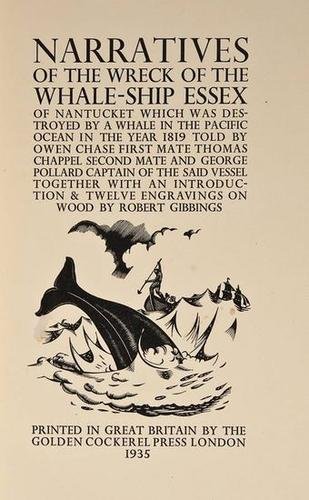
Just for fun, here's the extraordinary harpooning picture fulfilling its purpose...


Only 275 copies of this book were printed, so it's rather expensive (sigh). I love to see commissioned wood engravings in their intended context; they work so well with text.