Thursday, 29 January 2015

No Hope for the Last Ravilious Mural?

Surviving mural by Mary Adshead at Victoria Pier, Colwyn Bay
I was alerted to a recent article by Nick Booth in The Times about the Ravilious mural on the pier at Colwyn Bay. The mural was only rediscovered a couple of years ago, and there were hopes - which I described at the time - that it might be saved. Now the situation is apparently looking rather less hopeful, though whether the mural is, as reported, 'too far gone' to be saved, or whether it just doesn't fit into the proposed redevelopment plans, I don't know.

If anyone has further news, do leave a comment below.


Tuesday, 13 January 2015

RAVILIOUS at Dulwich Picture Gallery

Eric Ravilious, The Westbury Horse, 1939, Towner
Exciting news for fans of Eric Ravilious. Following smaller exhibitions at Towner (2010), the Fry Art Gallery (2011) and RWA Bristol (2012), Dulwich Picture Gallery is hosting the first major London show since the 2003 centenary exhibition. Opening in April, the Dulwich show will be the first big museum exhibition to focus specifically on the artist's watercolours. 

As curator, I've tried to balance well-known paintings like 'Train Landscape' and 'Tea at Furlongs' with watercolours that will be new to most people. People who have read my books or heard me lecture will know that I tend to be fairly down to earth in my approach; the first aim of the Dulwich exhibition is simply to show the best selection of available paintings, giving people an opportunity to see 'in the flesh' pictures they may already know from books and prints. 

Eric Ravilious, Dangerous Work at Low Tide, 1940, MoD Art Collection
I decided early on to arrange the paintings by theme, rather than in date order. That way we can break down the barrier between Rav's peacetime work and his career as a war artist, and look at the wartime pictures not as a separate group but as an integral part of the whole. 'Dangerous Work at Low Tide' may depict a military operation in early 1940, but it is also a study of dawn's early light that fits alongside peacetime paintings of similar subjects. Ravilious was limited in his choice of subjects during the war, but he retained his enthusiasm for enigmatic interiors and unusual perspectives.

Dulwich is perfect for this exhibition, which continues the venerable museum's series of shows devoted to 20th century British artists: John Piper, Ben and Winifred Nicholson, Paul Nash... not to mention David Haycock's 'A Crisis of Brilliance'.

I was there recently and had a look round the Emily Carr exhibition. Having known little about this Canadian artist I enjoyed her work very much. Her skies are really something, and I love the way she painted and drew forest trees. She reminds me a little of Georgia O'Keeffe, but her pictures seem more instinctive, more immediately expressive. I'll be going along for another look before the exhibition ends in early March

'Ravilious' opens next, on 2 April 2015. 


Tuesday, 30 December 2014

Ravilious fans - watch this space!!


Eric Ravilious, Newhaven Harbour, lithograph, 1936/7

Hello! I do hope you all had a fantastic Christmas and are looking forward to the new year. Exciting news for Ravilious fans coming up in 2015! Look out for an announcement in the middle of January, when all will be revealed...

Tuesday, 30 September 2014

The Lost Watercolours of Edward Bawden

Edward Bawden, February 2pm, 1936, private collection/estate of Edward Bawden
It seems amazing that seven years have passed since Tim Mainstone of The Mainstone Press commissioned me to track down the shops portrayed by Eric Ravilious in his remarkable 1938 book 'High Street'. I spent one memorable day racing around London, armed with a folder of pictures and an annotated A-Z, trying to visit a dozen or more sites before dark, and another with Tim exploring the Hedinghams in the pouring rain.

Writing about art and artists is always enjoyable, but there's nothing quite like a quest. Come to think of it, all of the books I've written have involved at least an element of sleuthing. Finding locations is always fun, but so is teasing out a new influence or connection. Top of the list, though, is discovering a painting. When JS Auctions sent me a photo of the Ravilious watercolour 'Aldeburgh Bathing Machines' it hardly seemed possible that such a beautiful painting had been hidden away for so long.

Although it was the Ravilious that made the money in last Saturday's auction, Tim and I were equally excited by the discovery of a second painting that had not been seen for many years, Edward Bawden's watercolour showing the back of Brick House, Great Bardfield, and entitled 'February, 2pm'.

The auctioneers kindly took the time to show me both paintings last week, and while the Ravilious was, as Anne Ullmann put it, 'an absolute corker', the Bawden was full of surprises. I knew that he liked to work on non-absorbent paper so that he could scratch into the paint, but I had never seen the results of this approach up close. It looked as though Jackson Pollock had lent a hand with a welter of scratch marks, pencil scrawl and jagged stabs of pastel.

Which makes our new Mainstone Press quest that much more exciting. The art world has rather forgotten that in the 1930s Edward Bawden was renowned not only as a talented illustrator and designer but also as a watercolourist of great skill and daring. Exhibitions at the Zwemmer Gallery in 1933 and Leicester Galleries in 1938 were well received by critics and buyers alike, and it was this commercial success that now makes the paintings so hard to find.

Many of the pictures disappeared into private collections and have rarely, if ever, been seen since. And the task of locating them is made rather more difficult by the fact that the 1933 paintings were given lines of poetry for titles - often cleverly apt lines, but too wordy for everyday use. Often the watercolours were given more straightforward titles by owners or dealers, so it is not easy to work out which is which.

However, the quest is going well, and a number of fascinating, often lovely and always inventive pictures have come to light. We'll be putting a book together in due course, so if anyone can help us find more of these pre-war Bawden watercolours, do get in touch with me or with The Mainstone Press.

MAY 2015 UPDATE I'm now working on the book. Meanwhile, new paintings continue to come to light, and my opinion of Bawden-the-watercolourist just keeps going up. His 1938 Leicester Galleries exhibition must have been one of the events of the year, judging by the twenty-something pictures that Tim has located. The paintings of Newhaven, in particular, are startlingly fresh and original.

DEC 2015 UPDATE The book is now in production!

Tuesday, 23 September 2014

A Pop-Up Bookshop for Art on the Hill


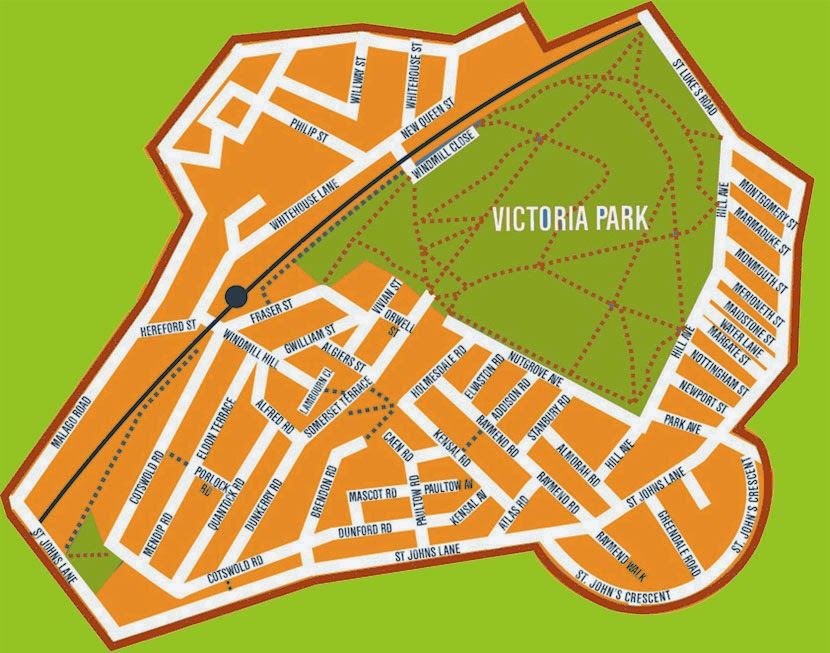
**NEWSFLASH** The 2014 Art on the Hill app is now available for iphone/android, which means you can wander the streets of Windmill Hill (above) and listen to artists chatting about their work. Congratulations to David Smith, who made it happen.

Our house in Windmill Hill, Bristol, will be temporarily transformed over the weekend of October 4th/5th into a pop-up bookshop and print gallery. My friend Christopher Williams will be exhibiting his rather wonderful linocuts and talking through his creative process with the help of precious sketchbooks, and I'll be selling my books about Eric Ravilious, Paul Nash, Peggy Angus and Edward Seago.

We're part of the 2014 Art on the Hill art trail, which covers Windmill Hill and Victoria Park in the southerly regions of Bristol. Have a look at the website and you'll see the diverse range of art and crafts on offer - I tried picking out some highlights but the list got too long. I'm particularly intrigued by Bedminster's smallest maze, which is advertised with the question: can you get lost in a front room? In ours yes, you probably can.

As on any art trail there are lots of fascinating houses to nose around in - because we're on a hill they tend to vary a lot in layout and views - as well as the park, city farm and community orchard. There are even musicians of one kind and another playing in the park and at venues around the trail, so it should be fun. If you do come along, pop in and say hello!


Thursday, 11 September 2014

Lost Worlds: Edwin Smith & Ed Kluz

Edwin Smith, church interior, 1950s, copyright Edwin Smith/RIBA Library Photo Collection
At some point in the late 1960s my grandparents went on a bit of a book-buying spree, so that when I was very young their house seemed to be packed with tomes too massive for me to lift. There were books on the Renaissance, Myths and Legends, Rembrandt and Picasso, but none of these were as huge as 'The English House Through Seven Centuries', which loomed so large it might have contained actual houses.

But eventually I was bigger than the book and years later I opened it to find myself in a lost world of moated granges, austere halls and cottages that seemed to have emerged fully formed from the earth. Photographed in black and white and with few signs of human presence, the buildings seemed to belong not so much to the past but to another reality, one that was rather nobler and a lot less messy than ours: the world of photographer Edwin Smith.

The text, by contrast, was sprightly. I didn't think it was possible to write about architecture without being crashingly dull but Olive Cook - Smith's wife and collaborator - soon had me hooked. She was a wonderfully lucid, entertaining writer and the ideal foil to her husband, and the pair were commissioned to create numerous books about English places and buildings. After Edwin's death Olive donated his life's work - some 60,000 negatives and as third as many prints - to the Royal Institute of British Architects, and a very select selection of these pictures has just gone on show at RIBA's gallery in Portland Place.

Edwin Smith, 'Ideal' fish & chip shop, London, 1958, copyright Edwin Smith/RIBA Library Photo Collection
'Ordinary Beauty' features images of urban scenes documenting British social life, atmospheric interiors and evocative landscapes overseas, along with published books and photographic equipment. Alan Bennett even makes an appearance on film, offering a personal take on Smith's life and work.

Olive and Edwin were great pals of Peggy Angus and Tirzah Ravilious (whose son James was inspired by the photographer in his choice of career), and they included Furlongs in their haunting book of English cottages. Smith's photo of the interior, which is reproduced in 'Peggy Angus: Designer, Teacher, Painter', is almost unique in making the cottage appear neat and tidy. I wonder if it's in the exhibition... (see below)

Meanwhile, in another part of the country... actually just down the road in Kent, Mascalls Gallery is about to launch an exhibition which also relates to buildings of the past. For a number of years Sussex-based artist Ed Kluz has been making collages and prints of old houses and eccentric structures, borrowing from a tradition that stretches back through John Piper to the topographers of the 18th century to create unmistakeably 21st century artworks.


Ed Kluz, Fonthill Abbey, 2013, collage (artist's copyright)
The Mascalls exhibition is Ed's first solo museum show, and for it he has found a particularly intriguing subject. In the Lincolnshire village where I grew up there was a park in which stood a humdrum brick building known as The Butler's Pantry. This was all that remained of the Hall, a grand old place with Jacobean origins, Georgian symmetry and a tower added by a Victorian; it was knocked down the year we arrived, leaving me with a tantalising half-memory of creeper-covered brick and empty windows.

Our Hall was one of countless houses of similar size that were demolished during the 1950s and 1960s, a state of affairs highlighted by the V&A's 1974 exhibition 'The Destruction of the Country House'. Now Ed Kluz is returning to the subject, and marking the 40th anniversary of the V&A show, with 'The Lost House Revisited', in which he explores both the creation and the destruction of Britain's great country houses. A must for Romantics!

Ordinary Beauty: The Photography of Edwin Smith is at RIBA until 6 Dec.
Ed Kluz: The Lost House Revisited is at Mascalls Gallery, Paddocks Wood, Kent, from 20 Sept to 13 Dec.

PS Made it to RIBA on Friday and thoroughly enjoyed the Edwin Smith show - I thought all those black and white images together might be a bit dry, but the exhibition is beautifully curated, with imaginative use of the room and larger displays to break up the photos. Highlights? A ploughed field with a farmhouse in the distance... A funerary statue from Pompeii... Pictures of clowns (a surprise, that). There were far more people in the photos than I had expected, mostly I think from before the war. Altogether a wonderful introduction to and celebration of a great 20th century talent.

There isn't a catalogue but Merrell have reissued 'Evocations of Place: The Photography of Edwin Smith', which I think came out originally in 2007. Very good reproductions of a wide range of work, and a readable essay by the late Robert Elwall. Would have been nice to have an essay putting Smith in context of our current rediscovery of all things mid-20th century - but you can't have everything!


Tuesday, 2 September 2014

A Ravilious Rediscovered

Eric Ravilious, Aldeburgh Bathing Machines, 1938 (photo JS Auctions)

Until this year only the owner of ‘Aldeburgh Bathing Machines’ knew of its existence. This scintillating watercolour was bought from the artist’s exhibition at Tooth’s in May 1939, and since then the title has been attributed to a different painting, also of bathing huts. As far as anyone other than the owner knew, the picture featured here had never existed, so that to Ravilious’s descendants, collectors and fans ‘Aldeburgh Bathing Machines’ is not a lost painting returned, but a new and exciting discovery.

Eric Ravilious was in the middle of a prolific period when he visited Aldeburgh late in August 1938. Galvanised by the prospect of the Tooth’s exhibition he had travelled around the country, seeking out inspiring subjects. His letters are generally a good source of information about his activities, yet we know almost nothing about his visit to Aldeburgh; he left no clue as to why he was so intrigued by bathing machines.

There were, however, similar devices on the beach at Eastbourne when he was a boy. Ravilious was born in London, but at the age of eight moved to the Sussex seaside town, where his father ran an antiques shop. A scholarship took him to the Royal College of Art in 1922, and from there his career as a designer and artist blossomed alongside that of his friend and fellow student Edward Bawden. Ravilious retained a lifelong fascination for unusual and old-fashioned objects, particularly wheeled vehicles.

He also liked to work in series, so we should not be surprised that he painted three watercolours of these delightful blue-and-white-striped bathing machines. In this case the composition is centred on the parking sign and its shadow, around which the other objects (and the attendant) are carefully arranged so that the eye keeps moving from one to the next as if around a dial. The objects themselves are intriguing even by Ravilious’s high standards of oddity: the chicken appears in another painting and must have had some purpose, but we don’t yet know what it was. Having no doubt seen his friend John Piper’s illustrated essay on ‘Nautical Style’ in Architectural Review a few months earlier, Ravilious may have included the fowl as an amusing addendum.

However, the most striking feature of this beautiful painting is the quality of the light. Dawn was this artist’s preferred time for outdoor work, and in many watercolours it is the radiant early morning light that seems his true subject. The striated iridescent sky would become a feature of Ravilious’s finest wartime paintings, but this is peacetime, and the scene is set for a holiday.

'Aldeburgh Bathing Machines' is going under the hammer at JS Auctions on Sept 27. I wrote the text above for the catalogue.

In other news, Towner will be opening its Ravilious room on Sept 12. This will be a resource room for fans of the artist, with an evolving display of work, plus books, documents, etc. Obviously I haven't seen it yet, so do contact the museum if you want to know more.

Thursday, 31 July 2014

Random Spectacular #2

Cover of Random Spectacular #2 by Jonny Hannah

Amazingly, almost four years have passed since St Judes published Random Spectacular, a delightfully eclectic collection of words and pictures that reminded me of the old Saturday Books. The edition sold out so quickly that everyone was taken by surprise, not least editor Simon Lewin, and some St Judes devotees were unable to get hold of a copy.

This time around, Simon is taking the unusual step of basing the edition size on the apparent demand. Anyone interested in buying a copy should trot along to the St Judes website and enter their email address. NB this doesn't mean they're guaranteed a copy, but they will be sent payment information by email when Random Spectacular #2 is published in August 2014.

There are some treats in store for fans of Mark Hearld, Emily Sutton, Angie Lewin and numerous other artists, and the whole book is beautifully designed. I was delighted when Simon asked me to write something on Eric Ravilious's submarine lithographs: look out for some gorgeous full page reproductions.

FFI: St Judes


Monday, 21 July 2014

A Modern British Summer!

Paul & John Nash reunited at RWA Bristol
For a long time the auction houses and dealers have been enjoying a boom in Mod Brit, as 20th century British art is known in the trade. Or rather, as 20th century British painting, sculpture and artist-made design is known.

For those baffled by artspeak, there's a world of difference between 'modern', which now refers to a period from about 1910 to the beginning of the Saatchi era, and 'contemporary', which refers to art being made now - or some of it, at least. For art to be 'contemporary' it generally needs to be non-traditional, as 'modern' art used to be. Nowadays Edward Seago is 'modern', and you don't get much more traditional than him.

JD Fergusson, Bathers: Noon, 1937, (c) The Fergusson Gallery
Of course some Mod Brit artists really were modern. Take JD Fergusson, the Scottish painter who immersed himself in the vibrant visual culture of early 20th century Paris and brought home a wild palette and a boundless zest for life. One of the world's great colourists, he has remained popular since his death in 1963 - but neglected south of the border. Now, however, Pallant House is offering English fans an opportunity to revisit Fergusson's work, as curator Simon Martin explained to me recently.

'Over the past few years,' he told me, 'Pallant House Gallery has carved a niche in presenting reappraisals of overlooked British artists and themes.

'The JD Fergusson exhibition has come to us from the Scottish National Galleries and is very timely as it the first solo museum show of this Scottish Colourist in England for over forty years, and demonstrates the important point that British artists were not working in a vacuum, but working in continental Europe as part of the international avant-garde.'

Great exhibition, great catalogue...
Simon made a name for himself a few years ago with a brilliant exhibition devoted to another overlooked British artist, Edward Burra - a painter of extraordinary originality and verve - and since then Pallant House has become one of several out-of-London museums catering to the renewed interest in all things Modern and British.

Dulwich is only just out of London, but the need for visitors to leave the West End and venture onto the rail network does make Dulwich Picture Gallery a not-quite-London venue. Famous for its gorgeous permanent collection, DPG has also embraced Mod Brit following the startling success in 2010 of 'Paul Nash: The Elements', David Fraser Jenkins' memorable exhibition.


Until 21 September you can enjoy 'Art and Life', a delightful exhibition devoted to the work of Ben and Winifred Nicholson, Christopher Wood and others, in an environment ideally suited to the pictures. These artists, like many of their generation, painted on a relatively modest scale, and the work feels at home in the intimate exhibition gallery at Dulwich. I enjoyed seeing the exhibition at Kettle's Yard, but the paintings come to life in a different way in their current home - worth taking the ten-minute train ride from Victoria to see them again!

Closer to home (for me, at any rate), and close to my heart, is the new RWA exhibition devoted to the careers of Paul and John Nash. I have spent a lot of time over the past few years writing about, thinking about, and generally going on about Paul Nash, and I wish there weren't so many books about him so I could write another one. Oh well.

Paul Nash, Dymchurch, c1922-4, Dudley Museums Service, (c) Tate
A few years ago I had the idea of celebrating the centenary of the Nash brothers' first (and only) joint exhibition, which took place in 1913. I approached the RWA, with whom I had worked on an exhibition of Ravilious watercolours, and they decided to include 'Brothers in Art' as part of their impressive Great War centenary programme. I've been too busy elsewhere to get involved, but curator Gemma Brace has put together a mouth-watering selection of pictures by both artists, including one of the nation's favourite paintings, John's 'Cornfield'.

Like many smaller institutions the RWA is handicapped by the prohibitive charges levied by larger museums and estates for reproduction rights, making it very difficult for them to promote the exhibition nationally, but I hope that word spreads around the grapevine. There are pre-Great War paintings by both artists that have rarely, if ever, been shown publicly before, along with later pictures that are justly celebrated. From Paul a lovely oil of Dymchurch and 'Eclipse of the Sunflower', from John languid views of Bath and the eye-of-God vision of 'Gloucestershire Landscape'.

Almost my favourite picture on public display anywhere in Britain right now is Paul Nash's early watercolour of elm trees in the blue summer dusk, which is featured in the exhibition.

Meanwhile, in another part of the country... we have Towner's wonderful Peggy Angus show, which is full of surprises. When Sara Cooper and I were planning the exhibition we faced a particular challenge in the varied nature of Peggy's career. On the surface, at least, her paintings are very different from her tile designs, and what about her long and distinguished teaching career? How on earth do you represent years in the classroom in a museum show?

As it turned out, her fabulous wallpaper (hand-printed for us by her grand-daughter Emma Gibson) offered a way of pulling the disparate aspects of her career together - as well as causing a lot of jaws to drop. Besides, these different sides of her life were not actually so different. Look for instance at the curving line of the railway in one of her paintings of Asham Cement Works, and then at the undulating design in her Lansbury tile mural, and you can see the same hand behind them. Similarly, the design work she did in the classroom relates closely to her commercial work. Thanks in part to Towner's moveable walls, the exhibition flows nicely, showing us different sides of a single, inspiring, creative mind.
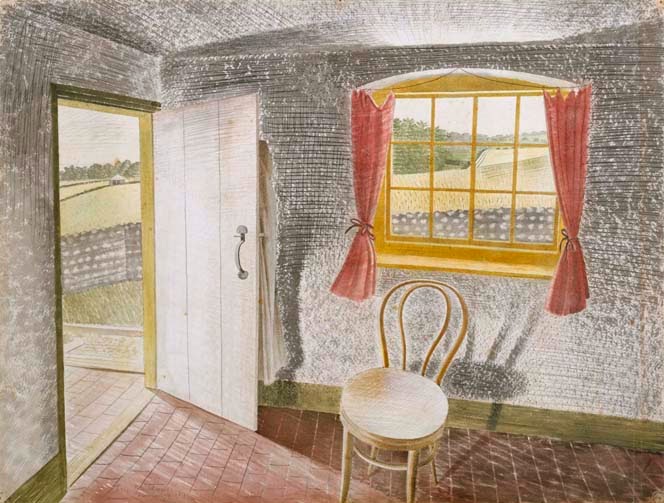
Eric Ravilious, Interior at Furlongs, 1939, Towner

Peggy Angus, The Three Bears, c1945, (c) Estate of Peggy Angus/DACS
We thought a great deal about whether to include Ravilious paintings in the exhibition and decided they were so immediately relevant - given the artists' friendship and shared artistic interests - that it would be crazy not to. Although Ravilious was the superior painter overall, I don't think Peggy's pictures of the cement works, or of Furlongs, suffer by comparison.

Rather, his 'Interior at Furlongs' and her paintings of the same subject complement one another, while the fantastic stage set of the famous table and chairs is a must-see for any true Ravilious devotee. There is even an oil lamp on show that he bought for Peggy from a Lewes junk shop.

In part I think the growing fascination with all things Mod and Brit has a lot to do with our distance from those days, especially the 1930s. You have to be of a fairly decent age now to remember the decade with any clarity, and for those born in wartime or afterwards it has the same air of mystery and nostalgia that the Victorian period had for their parents. For young artists and designers, meanwhile, Peggy Angus must come as something of a revelation - a talented maverick who enjoyed not one but several careers, leaving behind an extraordinary body of work.

FFI:
JD Fergusson at Pallant House
Art and Life at Dulwich Picture Gallery
Brothers in Art: Paul and John Nash at RWA Bristol
Peggy Angus: Designer, Teacher, Painter at Towner


Also playing:

From David Bomberg to Paula Rego: The London Group in Southampton at Southampton City Art Gallery - a century old this year, having been set up on the eve of the Great War to help artists who were shunned by the Establishment, the London Group is still going strong today. It describes itself as 'a thriving democratic co-operative of artists practicing in all disciplines, from painting and sculpture to moving image and performance, with a full annual events programme in London and beyond.'

Keith Vaughan at the Fry Art Gallery, Saffron Walden - an exhibition 'specially devised to reflect the influence of north west Essex on Vaughan by showing 'Essex work'. Vaughan enjoyed relaxing in the Essex countryside where he could explore the constant changes in the natural world and the open sky as a contrast to his life in London. He was also interested in the juxtaposition of geometric shapes provided by vernacular architecture. Many of his later paintings can be traced back to photographs that he took in Essex whilst living at Harrow Hill.'

Kenneth Clark - Looking for Civilisation at Tate Britain

Apologies if I've missed out something obvious - please add a comment!


Wednesday, 16 July 2014

Peggy Angus on Film


This film was shot just before the Private View of the Peggy Angus exhibition at Towner last week. You have to wait a while for David Dimbleby, but there are some great pictures of the show. Sara got to stand in front of the Sun and Moon wallpaper, which is most unfair.

The film was made by Bourne Iden TV.

Peggy was also featured in The Observer a couple of weeks ago; you can see the article by Rachel Cooke and accompanying slideshow on the Guardian website.

I'm back in Eastbourne on Saturday (19 July), giving an afternoon talk on Peggy's life and work... The weather forecast isn't very good for Saturday, so why not come and be entertained for an hour! Info here.